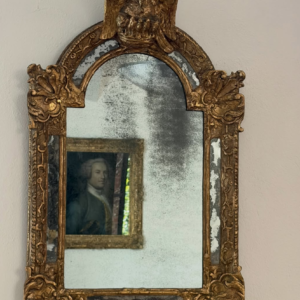
My customer that bought the yew wood drop side table recently, pointed out an 18th century antique French Régence carved giltwood wall mirror she bought elsewhere, had a replaced central mirror, the fake ageing spoilt the overall.
Notice photo 5, fake age. She’s an aesthete like myself and everything’s perfect within her home. I told her I’ve saved mirrors since before I opened 1990. I even knew the one that would suit best.
I went back to the workshop and located the one I was thinking of, a 19th century English carved mirror back.
Made me happy to finally make use of this, that I’d bought around 30 years ago. Dealers hold so much stock, materials, veneers ( hundreds of sheets of veneer) anyway back to the story.
I called David Davies, he worked with me on and off for decades, he cuts old mirrors and glass, it’s fascinating to watch. But nail biting, as to get the corners rounded, he has to use pliers, won’t say anymore, but my teeth are still hurting from the cracking!!
Anyway, he cut the mirror successfully, note: the other 2/3 of the mirror remains in my warehouse.
Let me know if you could use a piece.
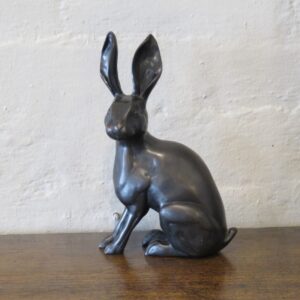
Elegant trio of vintage retro black glass birds. The black pair now joined by an off white interloper.
An interesting word to name the welcomed new addition, quite the opposite to be honest. But was just thinking of the Labor PM and Greens leader and for some reason “Interlopers” came into my mind!
However, not wanting to be political on my business page, I shall stop!
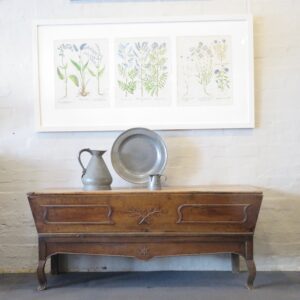
The three plank cleated top (later hinged – originally sliding)
Above canted bin, with original leaf and moulded carving.
Resting on a shaped, moulded skirt with a carved central star, joined to front cabriole legs.
Still to be re-glued, and re wax finished.
Or left un waxed, as beautifully oxidised over the centuries.
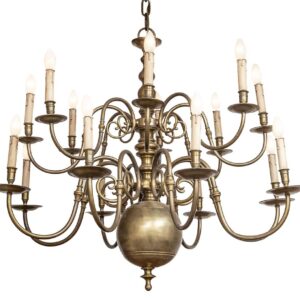
19th Century Style Flemish Brass Electrolier of Wide Proportions
A double headed Eagle, above a beautifully turned coloumn, having eight scrolled arms.
‘One of the most intriguing and powerful ancient symbols is the mysterious double-headed eagle that has been with us for millennia. It is believed to be one of the world’s oldest symbols used by a number of diffrent ancient cultures. The earliest depiction of the double-headed eagle can be found on ancient Hittite monuments in central Anatolia. In the early 19th century, in Boğazkale, an old Hittite capital in modern-day Turkey Charles Texier discovered cylindric seals with clearly visible two-headed eagle with spread wings. The double-headed eagle motif originally dates from c. 3800 BC. The Hittites had worshipped the double headed eagle as the King of Heaven, who was also called the Hittite Bird of the Sun. The bird was their symbol to signify Hittite military power’ -messagetoeagle.com