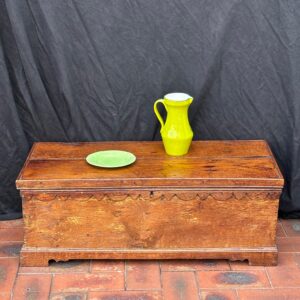

Late Tudor / early Renaissance carved oak panels (circa 1520–1560), presented within a later Arts & Crafts period outer frame (late 19th / early 20th century).
This is a classic composite, or “married,” construction of the kind long recognised in the trade: a later carcass carefully built to showcase much earlier salvaged fragments. The front facade consists of highly distinctive Tudor-period carved oak panels that capture the transitional phase between Late Gothic and Early Renaissance design in England.
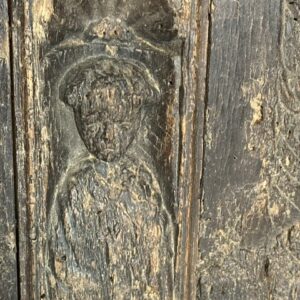
The architectural arrangement of the facade is divided into vertical framed panels that derive directly from traditional medieval joinery. Arcaded structures contain primitive figures, characteristic of late medieval and Henry VIII-period carving, flanking a central panel of stylised, interwoven geometric motif. The three principal panels display a deeply incised geometric design, with trees or vines appearing on the side panels. Figures stand beneath carved archways in a manner strongly influenced by continental Renaissance designs that reached England and Flanders in the early sixteenth century, a style often described as “Romayne” or architectural caryatid carving.
These panels may originally have formed part of a fifteenth- or early sixteenth-century marriage chest (cassone), or been taken from Tudor oak wainscoting or dismantled bed heads in manor houses. Their surface shows severe age-related degradation, chipping and deep vertical checking on the lower sections, creating a heavily eroded, dry texture that contrasts markedly with the smoother structural frame surrounding them. Historic borer trails are present, as is typical of early oak. These are long extinct, with stable oxidisation and no evidence of active infestation.
The outer frame (stiles, rails and top lid) is a reconstruction of the Arts & Crafts period, when craftsmen held a particular reverence for medieval and Renaissance joinery and routinely salvaged original fragments from decaying estates to create new, functional pieces.
Two conservation options are under consideration: careful removal of the Tudor panels for independent conservation, sealing, wax finishing and reverse-framing on an antique velvet-covered timber panel (in the manner of the sixteenth-century Flemish oak panel of a rising angel previously offered), or retention of the complete composite structure with gentle restoration of the front panels and wax finishing of the surrounding coffer. Both approaches respect the historical integrity of these early carvings.
A rare and evocative survival of the transitional Tudor period, offered with complete transparency as a composite construction of genuine early panels within a later frame.
Panel
42 x 95cm
Coffer
H.66
W.120cm D.36cm
Call or text me for further details or to arrange a viewing.