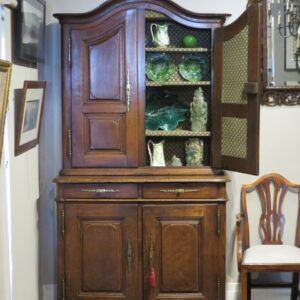
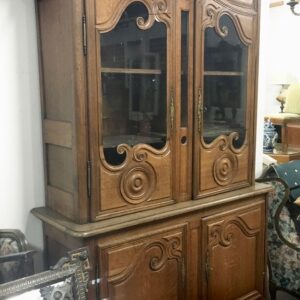
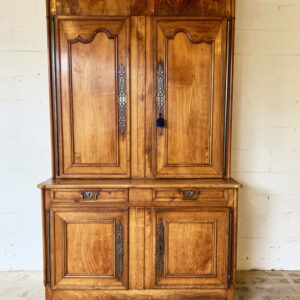
This is French with strong English Hepplewhite influences.
Over the years I’ve sold many, usually slight or profusely carved.
This example has elegant modern like lines, beautifully worn and patinated. All original brass-work.
The standout piece in a modern apartment living room, entrance or hallway. Stunning lines indeed.
Beside 18th century English country Hepplewhite dining chairs. Notice the influence in style.
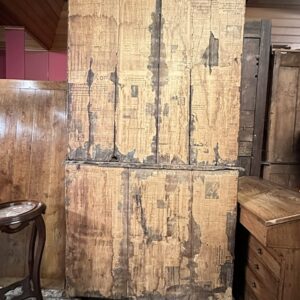
The 1940s Paris newspapers stuck to the backboards, adds yet another interesting touch to this rare 18th Century French Oak Buffet Deux Corps, of Small Proportions
This is French with strong English Hepplewhite influences.
Such an interesting piece.
As I said, usually carved, also usually much larger proportions.
H.230cm W.120cm D.50cm
Included on my Retirement SALE,
$16,500 reduced to $8,250
Paying attention to the overall beauty of the rare pieces I’ve sold is one of my more enjoyable pastimes. Finding that unseen knot to the grain of one of the solid oak rear planks, or to the inside of a square tapered leg of a farmhouse table (upcoming post),
Or the small section of sap-wood on the oak dresser base, riddled with long gone borer holes, always to me a great find. These little unseen touches to a piece really excite me.
I do find it a little sad that probably nobody else has ever noticed and missed out on immense pleasure I get from discovering these unique touches.
Yet another wonderful thing of dealing in country furniture, that unlike “town” pieces, a lot more perfect and certainly no place for a huge knot or a fallen knot making the timber imperfect and therefore unusable, so would be cut up to be used as corner blocks. With country or provincial pieces, these imperfections were overlooked, usually as good timber’s were scarce and they used whatever they had.
I’m sort of writing ahead for the upcoming story, but this also relates to this piece.
The 1940s Paris newspapers stuck to the backboards, adds yet another interesting touch to this rare 18th Century French Oak Buffet Deux Corps, of Small Proportions
This is French with strong English Hepplewhite influences. ref to my website, Furniture, French, Buffets.
Such an interesting piece.
Included on my Retirement SALE,
$16,500 reduced to $8,250
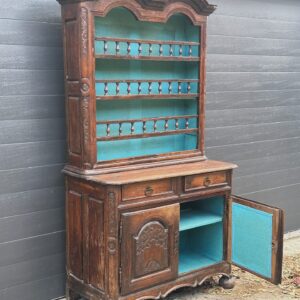
The strong William and Mary, Queen Anne from 1690 to 1710 influence, including the double arched carved pedemint steel drop handles and bold bun-feet.
With floral, leaf carvings to the facing rounded corners, a lot more worn to the base.
Turned finials supporting the rails for the display shelving, plain moulded drawers, so the beautifully carved arched fielded paneled doors of birds with out swept wings holding flowers.
Then a beautiful ogee-shaped bottom rail, resting on bold bun feet.
The well patinated two plank moulded top having a deep plate groove to the rear, to hold large upright dinner and serving plates.
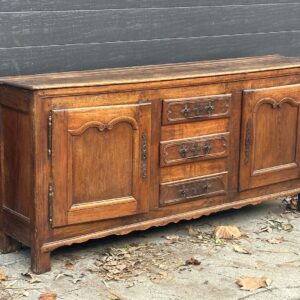
Above a stylish double mould, meeting with the sides to create a framed look. The three central drawers, flanked by two flowing mould carved paneled doors.
With a decorative applied ogee shaped long lower rail, joined to a continued slight shaped moulded foot.
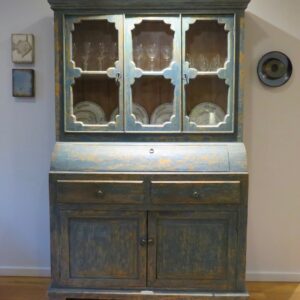
19th Century Continental display dresser/sideboard
The moulded cornice above two framed doors, the central fixed. The base having a domed hinged fall-front, opening to reveal a narrow storage compartment, above two rectangular drawers, then two paneled doors, all having steel ringed handles. Resting on plain bracket feet. The well worn blue rustic painted finish has been applied for many years and should be retained.
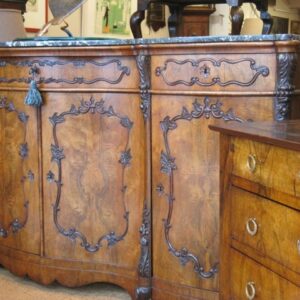
Last quarter 19th Century French serpentine rosewood sideboard.
The original shaped black marble top above three moulded drawers then four shaped carved panelled doors, having a shaped apron, the dividing corners having leaf and floral carved corners having leaf and floral carved corbel terminating to a short shaped carved cabriole leg.
The overall fading to the book-matched rosewood veneers has produced an exceptional tone.
Note: the interior is veneered with polished figured mahogany and has shaped shelving to match and a lined wine drawer. The carcass is in four sections all bolt firmly together for clever transporting and reconstruction.
H: 3’ 4” – 102 cm W: 6’ 11” – 211 cm D: 2’ – 61 cm