

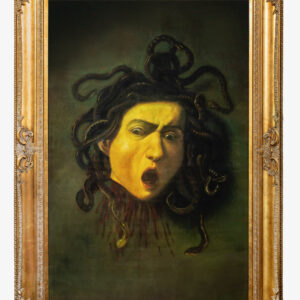
20th century pastel of Caravaggio’s Medusa 1597.
Frame 185cm x 132cm
Such a fascinating painter.
Love his work!
Selling for a customer.
DM me for details.
Photos by,
Russell Winnell Photography ✨
Michelangelo Merisi da Caravaggio
1571 – 1610
Showing 1–16 of 26 resultsSorted by latest
Frame 185cm x 132cm
Such a fascinating painter.
Love his work!
Selling for a customer.
DM me for details.
Photos by,
Russell Winnell Photography ✨
Michelangelo Merisi da Caravaggio
1571 – 1610
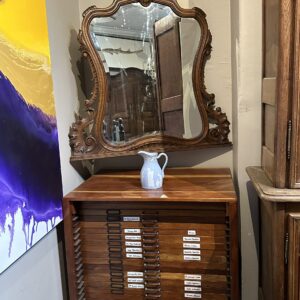
THIS ITEM HAS BEEN SOLD
As you can see, I’ve used this for my 16th to 19th century unframed engravings over the years,
As closing soon, have no more use.
Drawer sizes vary, divided (x8): W.38cm D.51cm / full length (x5): W.78cm D.51cm
H.89cm W.90cm D.69cm
Above: A 19th Century carved French walnut mantle/wall mirror.
Retaining the original, well aged bevelled mirror.
H.115cm W.108cm
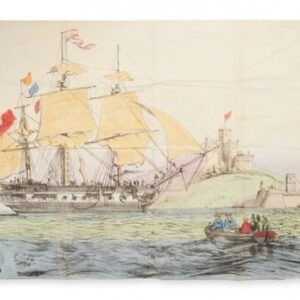
Australia: Arrival at Sydney
Anon (for Working Men’s Educational Union)
London : The Working Men’s Educational Union, King William Street, n.d. [circa 1860]. Coloured lithograph wall hanging printed on calico, 880 x 1200 mm, the lower left hand corner stamped Working Mens Educational Union. King William St, Trafalgar Square, London, and numbered 123 below; verso with contemporary manuscript caption at upper edge: Australia – arrival at Sydney; original brass eyelets at each corner with original sewn in linen loops for hanging; original fold lines (three horizontal and three vertical); the banner is in a remarkably good state of preservation, the colours still strong and vibrant.
A philanthropic organisation founded in London in 1853, the Working Men’s Educational Union provided free education for the working classes through public lectures at different venues across the city. This wall hanging, which would have been used as part of a display illustrating a lecture on the Antipodes, depicts newly arrived passengers being rowed from ship to shore in Sydney Harbour, with Government House and Fort Macquarie on the right. The immigrant ship is under both sail and steam (the first steam ship to arrive in Sydney was the Sophia Jane in 1831). Although the original artist is unidentified, the graphic is almost certainly after a published lithograph, possibly one which appeared in a journal such as the Illustrated London News. The dress of the passengers in the foreground suggests the original drawing would have been made around 1850.
The National Library of Australia holds twelve similar lithographic wall hangings commissioned by the Working Men’s Educational Union (Rex Nan Kivell Collection, NK801) which illustrate gold mining subjects. However, this particular grand scene of Sydney Harbour appears to be unrecorded.
The Alexander Turnbull Library in New Zealand holds four lithograph wall hangings bearing the Working Men’s Educational Union stamp. These depict scenes titled Panning for gold; Missionary distributing Bibles to Taranaki Maoris; Interior of Otaki Church (after Charles Decimus Barraud), and War dance before the pah of Ohinemutu, near Rotorua Lake (after George French Angas; in turn, after Joseph Jenner Merrett).
88 cm x 120 cm
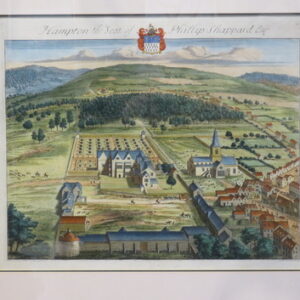
Jan Kip – Hampton – A Rare Early 18th Century English Copper Engravings of Grand English Estates 1708
Birdseye Maple Frame
66 x 74cm
Johannes “Jan” Kip (1652/53, Amsterdam – 1722, Westminster) was a Dutch draftsman, engraver and print dealer. Together with Leonard Knyff, he made a speciality of engraved views of English country houses.
Kip was a pupil of Bastiaen Stopendaal (1636–1707), from 1668 to 1670, before setting up on his own; his earliest dated engravings are from 1672. In April 1680, at the age of 27, he married Elisabeth Breda in Amsterdam. After producing works for the court of William of Orange in Amsterdam, Kip followed William and Mary to London and settled in St. John Street in Farringdon, where he conducted a thriving printselling business. He also worked for various London publishers producing engravings after such artists as Francis Barlow (c. 1626–1704) and Caius Gabriel Cibber (1630–1700), largely for book illustrations. He made several engraved plates for Awnsham & John Churchill’s A Collection of Voyages & Travels (first published 1704). He signed the African scenes in volume V of the 1732 edition as “J. Kip”.
His most important works were the large fold-out folio illustrations for Britannia Illustrata, 1708; for the 65 folio plates he engraved for the antiquary Sir Robert Atkyns, The Ancient and Present State of Glostershire, 1712 (1st edition); and for Le Nouveau Théâtre de la Grande Bretagne ou description exacte des palais de la Reine, et des Maisons les plus considerables des des Seigneurs & des Gentilshommes de la Grande Bretagne, 1715, an extended reprint in collaboration with other artists.
CMA206
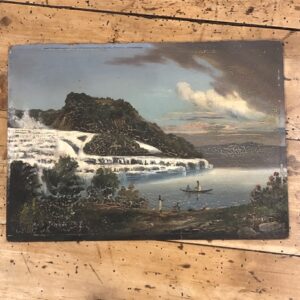
White Terraces – Mt Tarawera – William Binzer born 1850
Binzer painted in New Zealand through the 1870s and Australia 1880s, then returned to England.
Oil on Board
H.21.5cm
W.30.5cm
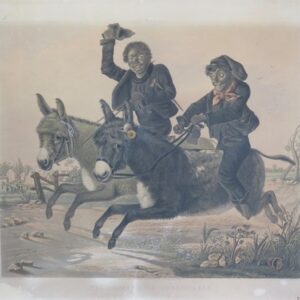
The Donkey – Ster Sweepstakes’ Engraving by Charles Hunt 1852
Painted by J.A.Fitzgerald, published London 1852
Years ago I bought this mid 19th Century English lithograph. It has sat around in my stores and found again recently.
The donkey race at the local county fair. I wonder if they’re chimney sweepers? One of my younger contempories stated, ‘He saw this in my shop window display recently, he continued to state the engraving was ‘Racist’?’ Sometimes I simply don’t understand our younger generation?
Anyway, I love this style of engraving. I removed the daggy frame, as I feel it looks much better with no interference.
H.57cm W.65cm
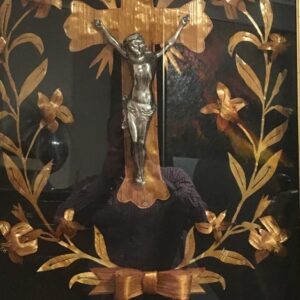
A Decorative 20th Century French Framed Jesus on Cross Three Dimensional Media
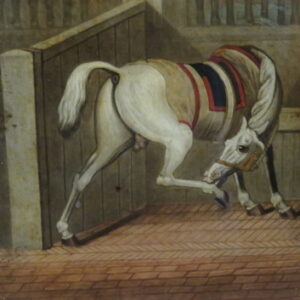
Thomas Burford (1710 – 1775) ‘Stables’ on Glass C.1760. After James Seymour
Line engraving from the famous Thomas Burford
Painted in body by James Seymour (1702 – 1752)
H. 41cm
W. 49cm
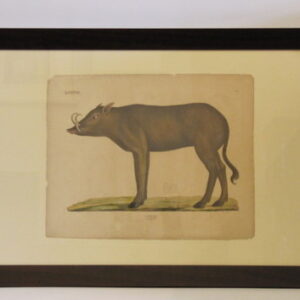
Stock CGW134468-3.4
‘Babirussa’
Pig-deer species found in Indonesia
19th Century coloured lithograph animal
A. Gatt
77 cm x 113 cm (framed)
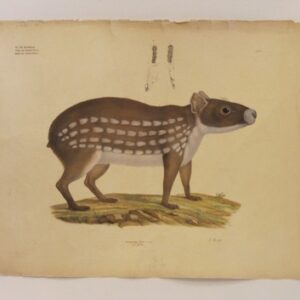
Stock CGW134468-3.3
‘Coelogenys Paca’ – small South American rodent
19th Century coloured lithograph animal
A. Gatt
49 cm x 62 cm (unframed)
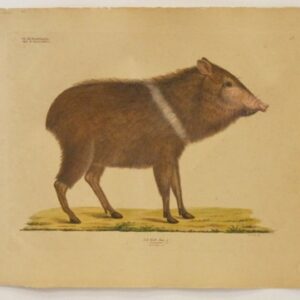
Torquatus’ – adorned with a white pigmented neck collar
19th Century coloured lithograph animal
A. Gatt
49 cm x 62 cm (unframed)
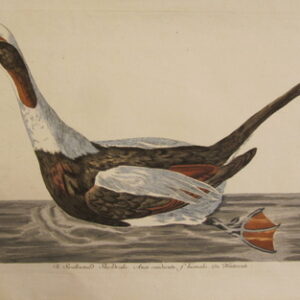
Stock CGW134469-12.4
“The Swallowtail’d Sheildrake”
Thomas Pennant (1726-1798) was a Welsh naturalist and travel writer, achieving distinction in both fields.
He attended Oxford University.
His natural history book “The British Zoology” was published in 1766 and was very influential to the study of Zoology.
Drawing by Peter Paillou, engraved by Johan Jakob Haid
36.5 cm x 53 cm (unframed)
60.5 cm x 79 cm (framed)
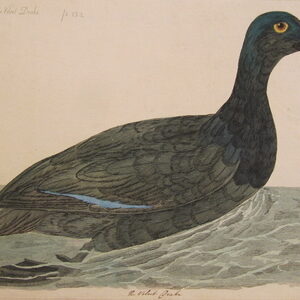
Stock CGW134469-12.6
“The Velvet Drake”
Thomas Pennant (1726-1798) was a Welsh naturalist and travel writer, achieving distinction in both fields.
He attended Oxford University.
His natural history book “The British Zoology” was published in 1766 and was very influential to the study of Zoology.
Drawing by Peter Paillou, engraved by Peter Mazell
60.5 cm x 79 cm
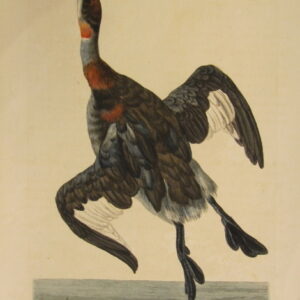
Stock CGW134469-12.3
“The lesser crested Grebe” P. 133
Thomas Pennant (1726-1798) was a Welsh naturalist and travel writer, achieving distinction in both fields.
He attended Oxford University.
His natural history book “The British Zoology” was published in 1766 and was very influential to the study of Zoology.
Drawings by Peter Paillou, engravings by Peter Mazell.
53 cm x 36.5 cm (unframed)
79 cm x 60.5 cm (framed)
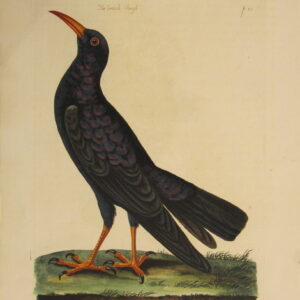
Stock CGW134469-12.2
“The Cornish Chough” P. 83
Thomas Pennant (1726-1798) was a Welsh naturalist and travel writer, achieving distinction in both fields.
He attended Oxford University.
His natural history book “The British Zoology” was published in 1766 and was very influential to the study of Zoology.
Drawings by Peter Paillou, engravings by Peter Mazell.
53 cm x 36.5 cm (unframed)
79 cm x 60.5 cm (framed)
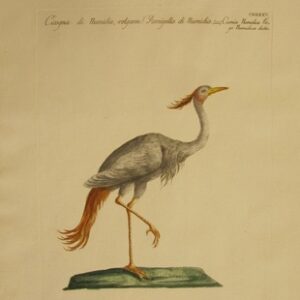
Manetti Birds – 1760