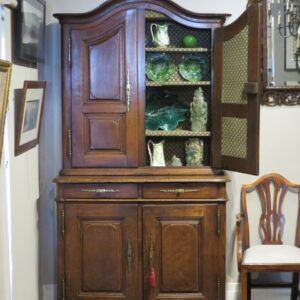
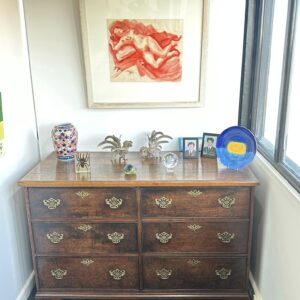
This is French with strong English Hepplewhite influences.
Over the years I’ve sold many, usually slight or profusely carved.
This example has elegant modern like lines, beautifully worn and patinated. All original brass-work.
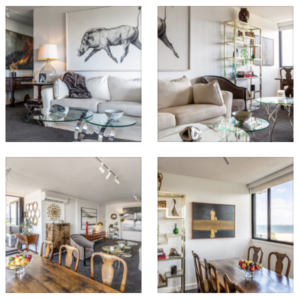
The standout piece in a modern apartment living room, entrance or hallway. Stunning lines indeed.
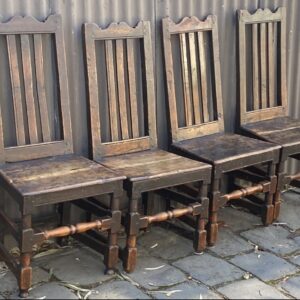
Beside 18th century English country Hepplewhite dining chairs. Notice the influence in style.
The 1940s Paris newspapers stuck to the backboards, adds yet another interesting touch to this rare 18th Century French Oak Buffet Deux Corps, of Small Proportions
This is French with strong English Hepplewhite influences.
Such an interesting piece.
As I said, usually carved, also usually much larger proportions.
H.230cm W.120cm D.50cm
Included on my Retirement SALE,
$16,500 reduced to $8,250
This is a classic composite, or “married,” construction of the kind long recognised in the trade: a later carcass carefully built to showcase much earlier salvaged fragments. The front facade consists of highly distinctive Tudor-period carved oak panels that capture the transitional phase between Late Gothic and Early Renaissance design in England.
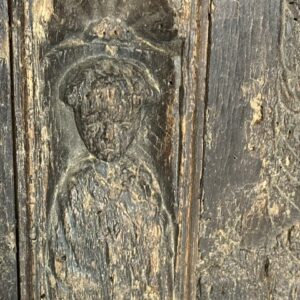
The architectural arrangement of the facade is divided into vertical framed panels that derive directly from traditional medieval joinery. Arcaded structures contain primitive figures, characteristic of late medieval and Henry VIII-period carving, flanking a central panel of stylised, interwoven geometric motif. The three principal panels display a deeply incised geometric design, with trees or vines appearing on the side panels. Figures stand beneath carved archways in a manner strongly influenced by continental Renaissance designs that reached England and Flanders in the early sixteenth century, a style often described as “Romayne” or architectural caryatid carving.
These panels may originally have formed part of a fifteenth- or early sixteenth-century marriage chest (cassone), or been taken from Tudor oak wainscoting or dismantled bed heads in manor houses. Their surface shows severe age-related degradation, chipping and deep vertical checking on the lower sections, creating a heavily eroded, dry texture that contrasts markedly with the smoother structural frame surrounding them. Historic borer trails are present, as is typical of early oak. These are long extinct, with stable oxidisation and no evidence of active infestation.
The outer frame (stiles, rails and top lid) is a reconstruction of the Arts & Crafts period, when craftsmen held a particular reverence for medieval and Renaissance joinery and routinely salvaged original fragments from decaying estates to create new, functional pieces.
Two conservation options are under consideration: careful removal of the Tudor panels for independent conservation, sealing, wax finishing and reverse-framing on an antique velvet-covered timber panel (in the manner of the sixteenth-century Flemish oak panel of a rising angel previously offered), or retention of the complete composite structure with gentle restoration of the front panels and wax finishing of the surrounding coffer. Both approaches respect the historical integrity of these early carvings.
A rare and evocative survival of the transitional Tudor period, offered with complete transparency as a composite construction of genuine early panels within a later frame.
Panel
42 x 95cm
Coffer
H.66
W.120cm D.36cm
Call or text me for further details or to arrange a viewing.
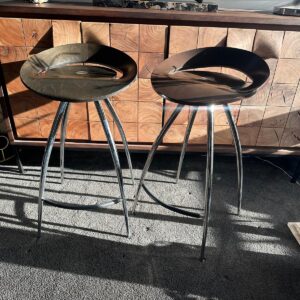
Designed for Design Group Italia in 1990 and manufactured by the Italian brand Magis.
This classic postmodern design features an organic, curved bentwood plywood seat shell combined with a futuristic, tapered three-legged tubular chrome steel base.
Because of their enduring popularity, they were also famously distributed globally by Herman Miller.
The stools are in great condition.
Selling for a friend $750 pair
Happy to deliver inner city No charge…
Otherwise, pick up St Kilda West or North Fitzroy.
Words by Jamie Allpress, Allpress Antiques
Photography by Russell Winnell
Recently I was invited to re-arrange the entire contents of The Johnston Collection, to create my own interpretation and to give visitors to the house a fresh experience.
I heard about the Johnston collection many years ago and on seeing it was ‘enthralled’ by the overall quality and uniqueness of Mr Johnston’s collection.
This week we finally completed a chest of drawers I purchased around a decade ago.
I’m so glad I waited, as now looking perfect in my bedroom.
I Georgianised a 19th century English oak long chest (Victorian)
Originally had fancy shaped Victorian mouldings to the top and base. With turned rosewood handles, diamond shaped rosewood inlaid escutcheons and rosewood drawer cockbeading.
Had to bank a cheque this morning, sold a particularly nice small sized Regency style chest of drawers yesterday, several of my customers still use cheques.
Drove down to Acland St to deposit and had a coffee at Abbey Road Cafe.
My friend, the prettiest, grooviest, waitress in Melbourne, Simonè, always brings me the perfect coffee… (more below)
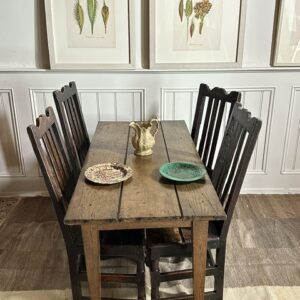
The ogee-shaped top rail above three plain rectangular scratch-moulded upright plats, supported by a lower rail, above two plank seats (some attractively knotted) resting on square block turned legs, terminating on a small pad-foot, with a high turned front stretcher, with double stretcher sides.
H.135cm W.46cm D.46cm
C.1700
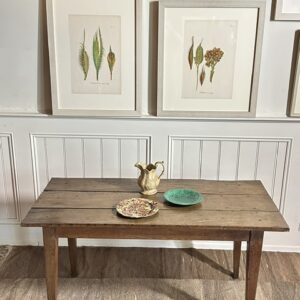
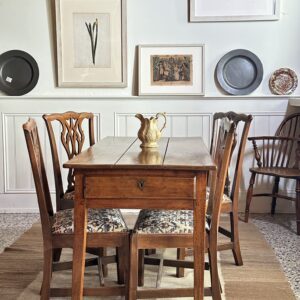
Perfect for a low farmhouse table, with narrow skirts, such as this one displayed. Or make some thick decoratively upholstered fitted cushions and use with a standard 76cm hightail farmhouse table, or use as two decorative pairs of side chairs.
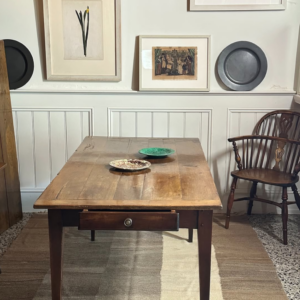
The well patinated three plank top, hand made nailed to the plain narrow skirts. Resting on square tapered legs, one having an unusual lost knot to the top, a nice conversation piece between oak lovers.
The narrow skirt matched with the lower set of four early English oak dining chairs, is a great match, as makes this comfortable seating.
See below the top, the beautifully blended natural oxidisation of the planks and inner skirts, the thickness of the skirts and the huge knot missing from the grain flow of one.
These unique characteristics are generally never seen, not even by most dealers, as it’s a restorer that gets to examine every nook and cranny, having the immense pleasure of discovery!
I say once again, you’ll never find this in perfect, polished town pieces, from any period.
This is why I adore English and European country furniture.
Perfect for creating a stylish kitchen/dining in a smallish space.
This post also featuring a set of four early 18th century English oak dining chairs. I’ll create another post for them.
Enjoyed my linguini bolognaise from @mariaspasta while photographing today.
Also reading up on 18th century Georgian wine tables, seeing a few similarities to many I’ve sold over the decades.
The well patinated faded three plank top, above a plain skirt, with chestnut lined cutlery drawer to one end, with the original shield shaped escutcheon, originally had a lock, unusual for a farmhouse table, so may have been made as a desk.
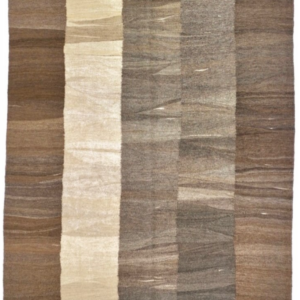
Neutral earthy tones of brown, cream, and taupe with delicate fringed ends.
288 x 184cm
Remarkable the difference a stylish rug can make to a room. The warm tones have beautifully disguised the over busy floor tiles. Changing the entire feel of the display space.
A home that feels less like a styled space and more like a deeply soulful, living canvas. The home belongs to Elizabeth: a fellow aesthete, a kindred Cancerian spirit, and a profound lover of trees.
Every corner tells a story of an intimate connection to the natural world. On the walls hang powerful, deeply moody graphite tree drawings of her own creation.
That intense reverence for timber, texture, and history flows effortlessly from her art right into her incredible collection of period furniture, beautifully layered together over the years from the Allpress Antiques collection also purchased from her travels around the world.
Watch the Reel to see how history and art intertwine in her sanctuary: