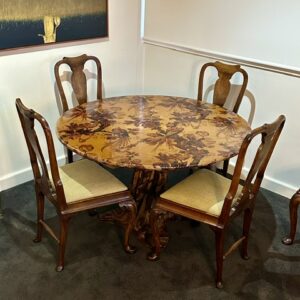
Below the circular top reveals the falling fabric continuing on to form the base.
Provenance: The table was selected by notable decorator Colin Bowman when both Madame Verna and he travelled to America for the furnishing of Verbu Lodge in early 1982.
(Video to come, Monday)
I restored the base this week as it had a little marking and the lower half had faded near flat.
So I cleaned back, coloured out the damages, then re varnished the entire base to match better with the top.
Such a dramatic difference, you’ll see better in the photos.
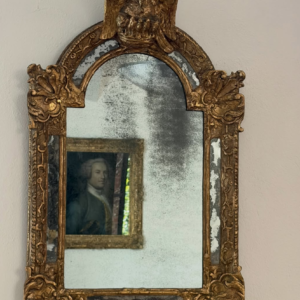
My customer that bought the yew wood drop side table recently, pointed out an 18th century antique French Régence carved giltwood wall mirror she bought elsewhere, had a replaced central mirror, the fake ageing spoilt the overall.
Notice photo 5, fake age. She’s an aesthete like myself and everything’s perfect within her home. I told her I’ve saved mirrors since before I opened 1990. I even knew the one that would suit best.
I went back to the workshop and located the one I was thinking of, a 19th century English carved mirror back.
Made me happy to finally make use of this, that I’d bought around 30 years ago. Dealers hold so much stock, materials, veneers ( hundreds of sheets of veneer) anyway back to the story.
I called David Davies, he worked with me on and off for decades, he cuts old mirrors and glass, it’s fascinating to watch. But nail biting, as to get the corners rounded, he has to use pliers, won’t say anymore, but my teeth are still hurting from the cracking!!
Anyway, he cut the mirror successfully, note: the other 2/3 of the mirror remains in my warehouse.
Let me know if you could use a piece.
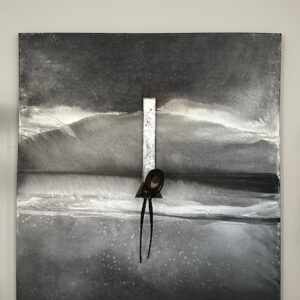
This piece of art is quite unique, I purchased two paintings from this artist at an overseas gallery 2013, kept this and sold the other, that you can see on an earlier post, including all the other pieces of art they purchased.
I enjoy the unique methods the artist created, certainly creates a mood wherever he hangs.
You’ll notice in my photos, how the piece changes in different lighting, I love the effects that vary.
For the past few years in the living room of my apartment, I’ve had both retro lamps either side, I love the more dramatic effects.
I’ve enjoyed having this painting since 2013. It’s featured in shows, window and shop displays and spent the past six years on my apartment.
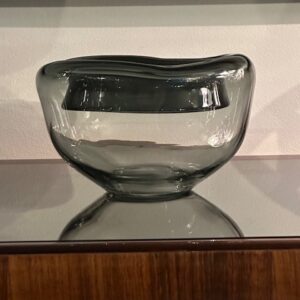
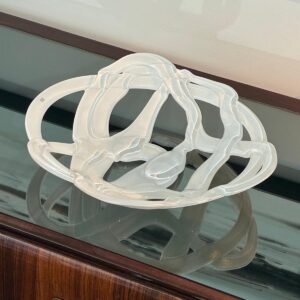
A substantial hand formed glass bowl with a softly rounded body and a thick, undulating rim. The darker smoky tone of the rim creates a strong contrast against the lighter, more transparent body below, giving the piece depth and a quiet sculptural presence. The rim is intentionally uneven, rising and falling in gentle waves, which reinforces its organic, tactile quality.
Heavy in the hand and refined in silhouette, it works equally well as a centrepiece, vessel, or standalone object.
Dimensions
Height 14 cm
Diameter 23 cm
Very good vintage condition.
• No chips, cracks, or structural damage
• Minor surface wear and fine scratches consistent with age and careful use
• Original maker’s mark no longer present
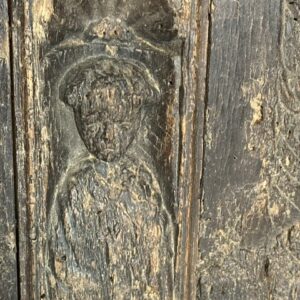
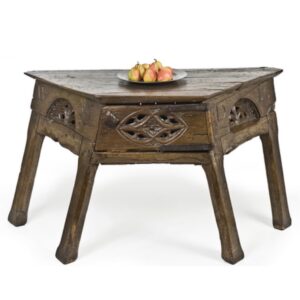
This is a classic composite, or “married,” construction of the kind long recognised in the trade: a later carcass carefully built to showcase much earlier salvaged fragments. The front facade consists of highly distinctive Tudor-period carved oak panels that capture the transitional phase between Late Gothic and Early Renaissance design in England.
The architectural arrangement of the facade is divided into vertical framed panels that derive directly from traditional medieval joinery. Arcaded structures contain primitive figures, characteristic of late medieval and Henry VIII-period carving, flanking a central panel of stylised, interwoven geometric motif. The three principal panels display a deeply incised geometric design, with trees or vines appearing on the side panels. Figures stand beneath carved archways in a manner strongly influenced by continental Renaissance designs that reached England and Flanders in the early sixteenth century, a style often described as “Romayne” or architectural caryatid carving.
These panels may originally have formed part of a fifteenth- or early sixteenth-century marriage chest (cassone), or been taken from Tudor oak wainscoting or dismantled bed heads in manor houses. Their surface shows severe age-related degradation, chipping and deep vertical checking on the lower sections, creating a heavily eroded, dry texture that contrasts markedly with the smoother structural frame surrounding them. Historic borer trails are present, as is typical of early oak. These are long extinct, with stable oxidisation and no evidence of active infestation.
The outer frame (stiles, rails and top lid) is a reconstruction of the Arts & Crafts period, when craftsmen held a particular reverence for medieval and Renaissance joinery and routinely salvaged original fragments from decaying estates to create new, functional pieces.
Two conservation options are under consideration: careful removal of the Tudor panels for independent conservation, sealing, wax finishing and reverse-framing on an antique velvet-covered timber panel (in the manner of the sixteenth-century Flemish oak panel of a rising angel previously offered), or retention of the complete composite structure with gentle restoration of the front panels and wax finishing of the surrounding coffer. Both approaches respect the historical integrity of these early carvings.
A rare and evocative survival of the transitional Tudor period, offered with complete transparency as a composite construction of genuine early panels within a later frame.
Panel
42 x 95cm
Coffer
H.66
W.120cm D.36cm
Call or text me for further details or to arrange a viewing.
Had to bank a cheque this morning, sold a particularly nice small sized Regency style chest of drawers yesterday, several of my customers still use cheques.
Drove down to Acland St to deposit and had a coffee at Abbey Road Cafe.
My friend, the prettiest, grooviest, waitress in Melbourne, Simonè, always brings me the perfect coffee… (more below)
Enjoyed my linguini bolognaise from @mariaspasta while photographing today.
Also reading up on 18th century Georgian wine tables, seeing a few similarities to many I’ve sold over the decades.
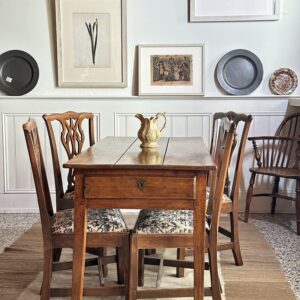
The well patinated faded three plank top, above a plain skirt, with chestnut lined cutlery drawer to one end, with the original shield shaped escutcheon, originally had a lock, unusual for a farmhouse table, so may have been made as a desk.
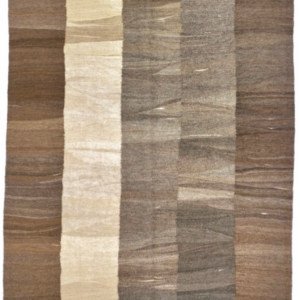
Neutral earthy tones of brown, cream, and taupe with delicate fringed ends.
288 x 184cm
Remarkable the difference a stylish rug can make to a room. The warm tones have beautifully disguised the over busy floor tiles. Changing the entire feel of the display space.
A home that feels less like a styled space and more like a deeply soulful, living canvas. The home belongs to Elizabeth: a fellow aesthete, a kindred Cancerian spirit, and a profound lover of trees.
Every corner tells a story of an intimate connection to the natural world. On the walls hang powerful, deeply moody graphite tree drawings of her own creation.
That intense reverence for timber, texture, and history flows effortlessly from her art right into her incredible collection of period furniture, beautifully layered together over the years from the Allpress Antiques collection also purchased from her travels around the world.
Watch the Reel to see how history and art intertwine in her sanctuary:
A pair of late 17th Century oak side chairs, North West England.
Each with rectangular scroll carved panelled back with scroll cut and guilloche, carved cresting embraced by pyramid finial surmounted uprights, solid seat on block and turned supports. Jointed by a turned front stretcher and multiple side stretchers.
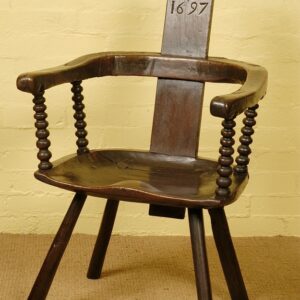
An outstanding and rare late 17th Century Oak and Elm primitive Windsor armchair – Wales. The slanted upright plank back slotted through the single plank bowed arm on four bobbin turned supports joined to the elm saddle seat raised by four tapered out swept legs. Dated 1697 with the initials later gouged out and showing signs of very old repairs including shaped iron braces applied by hand made nails.
Note: This chair is worthy of a museum and will probably never leave my personal collection. I have had the chair photographed in complete detail to display on my website and to be included in a future publication.
Sat in our dining room corner, appearing like a sculpture for many years, now sits in my apartment bedroom ✨
I saw an interesting story on researching the age of timber yesterday on Logan and Angelina’s @ourdollarhouse. Made me think of a few pieces I’ve sold and still have. This is a short story on the age of some rare pieces.
Being a semi retired antique and art dealer, specialising in furniture from that 16th – 20th century, I’ve had many pieces between 500 – 300 years old. Coming to mind,
One outstanding early 16th century Flemish oak credence table from 1520.
A small first half 17th century English oak livery cupboard 1600 – 1640
(both sold to the same Western District family)
an early to mid 17th century English oak refectory table 1600 – 1650, the thick removable cleated top, one single plank! Also graffitied T.A.S. 19/7/13, could’ve been scratched 1713 or 1813, I’d say 1713, due to the soft worn edges.
Truly amazing having this history in my hands. Actually, I recently bought that table back after selling to a friend 25 years ago!
I also sell art from 14th – 20th centuries. I have several large unused pages from a book of hand coloured copper engravings from 1686, actually by Hendrick Draakestein, how’s that for history. So the oak tree used for that 1520 credence table would have been at least 150 years old, so planted at least 1380. The wide plank of ok on the refectory table planted at least 1500.
Looks like we share a deep passion for history and timbers.
I also mentioned the 17th century paper I have from a book of botanical art by Hendrick Draakestein 1686, wonderful to have.
20th century Australian Regal Mashman drip glazed display bowl. Beautiful lines.
Also my personal small collection of Drip Glazed, Australian Deco Regal Mashman pottery. Always loved them.
18th century English George III country oak low standing chest of drawers.
SOLD chest and collection in my closing sale.