

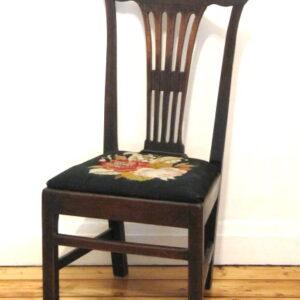
18th Century English Chippendale mahogany high back chair
18th Century English Chippendale mahogany high back chair
Showing 65–80 of 83 resultsSorted by latest
18th Century English Chippendale mahogany high back chair
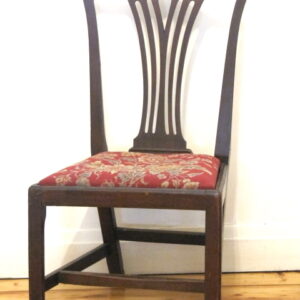
An 18th Century country fruitwood Hepplewhite chair
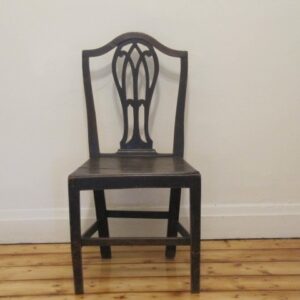
18th Century English elm dining/occasional chair
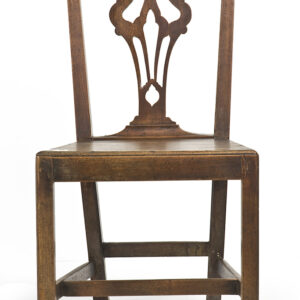
An 18th Century English Country Chippendale ash occasional chair.
The shaped top rail supported by a fret carved upright shaped splat above a wooden seat resting on square block legs joined by strechers.
C. 1780
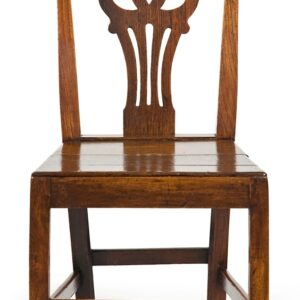
Late 18th Century English country Chippendale ash and oak occasional chair
The shaped top rail above a decorative wide fret carved centre splat, flanked by shaped tapered uprights. Having an oak triple plank seat, resting on square inward chamfered legs joined by stretchers.
C 1790
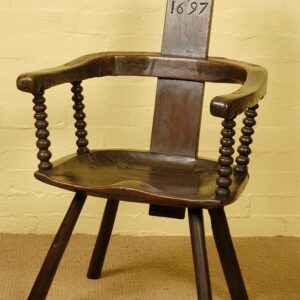
An outstanding and rare late 17th Century Oak and Elm primitive Windsor armchair – Wales. The slanted upright plank back slotted through the single plank bowed arm on four bobbin turned supports joined to the elm saddle seat raised by four tapered out swept legs. Dated 1697 with the initials later gouged out and showing signs of very old repairs including shaped iron braces applied by hand made nails.
Note: This chair is worthy of a museum and will probably never leave my personal collection. I have had the chair photographed in complete detail to display on my website and to be included in a future publication.
AA0803
H.109cm W.62cm D.63cm
Childrens Chair Clearance
We are having a major clearance on Childrens Chairs
Come in and see the gorgeous collection
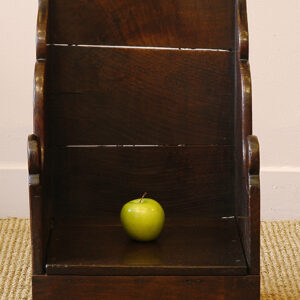
Stock AA0940
A rare 19th Century English oak childs winged armchair
This type of boarded armchair is commonly provided with wings. They are found in both North Wales and Northern England, and are possibly related to the ‘Lambing chair’ (restorations)
1820 – 1880
H. 2′ 1″ – 63.5 cm
W. 1′ 2″ – 35 cm
D. 1′ 2″ – 35 cm
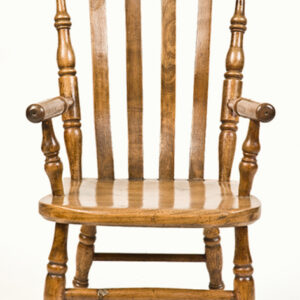
Stock AA1199
Late 19th Century English ash and beech child’s Windsor chair
C. 1880
H: 2′ 3″ – 69 cm
Stock AA0797
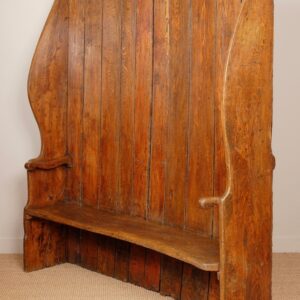
Early 19th Century English elm curved high settle.
This high curved settle was often situated at large fire places still common in the 19th Century. Their warmth seeking occupants were given protection from draughts, particularly when provided with winged slab ends and a small cornice, surrounding the matched boarded back. Having good colour and patination.
1820 – 1850
H. 5’ 7” – 169 cm
W. 4’ 11” – 158 cm
D. 1’ 1” – 32 cm
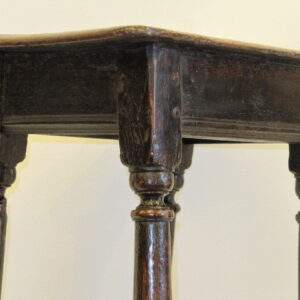
A 17th Century English oak joint stool. The rectangular thumb moulded single plank seat above a lower moulded apron, supported by four turned legs joined by stretchers with slight lower inward moulding. This stool having good overall colour and patina with much age and wear.
C. 1670
H: 51 cm W: 42.5 cm D: 29 cm
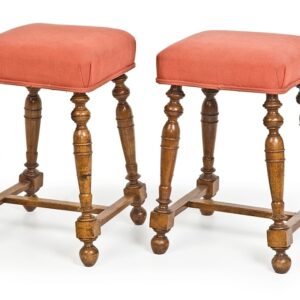
A rare pair of early 19th Century French fruitwood stools. The upholstered seats on well patinated fine baluster turned legs, joined by an ‘H’ stretcher.
C. 1810
H. 1’ 8” – 51 cm W. 1’ 2” – 35 cm
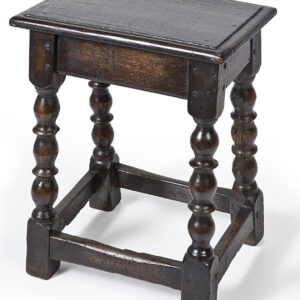
19th Century revival English oak joint stool.
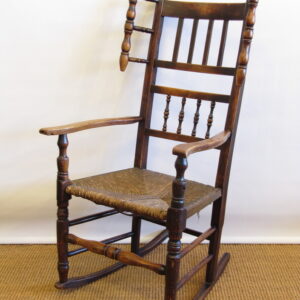
Mid 19th Century English Lancashire ash, elm and fruitwood winged rocking chair. The horizontal elm top rail above four vertical ash rectangular splats then a horizontal fruitwood rail above four turned ash finials fitted to the elm lower support rail. Flanked by ash turned wings attached to the uprights, below are slight shaped ash arms on ash turned supports, with a rush seat having a bold turned front stretcher and narrow turned side and rear stretchers, resting on shaped rockers. Good overall colour and patination.
Lancashire
1820 – 1860
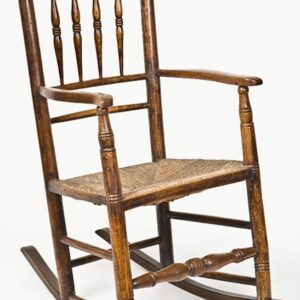
19th Century English ash and beech single row spindle back armchair rocker. The four decoratively turned spindles supported between a plain stay rail and one of two round cross rails. Joined to the round back uprights connected to the curved shaped arms, supported by turned supports, having a rush seat with edge protective strips above turned legs joined by a well turned front stretcher and double side stretchers, on rockers. Attributed to the Westmorland Dales area of the North West.
1800 – 1870
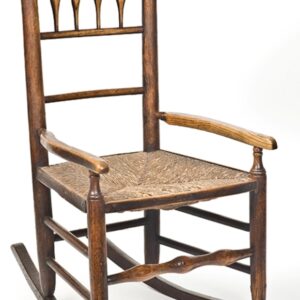
Dales or single row spindle back ash rocking armchair. Attributed to the North West. Round front legs tapering towards feet to mortice into rockers, joined by turned stretcher, shaped front and double turned side stretchers, below a rush seat. The round back uprights with single row of four decoratively turned spindles, supported between two round curved cross rails with additional cross rail below, curved shaped arms which mortice into the back upright with turned terminal tenons, plain turned underarm supports. Good overall colour and patination.
1800 -1870
Ref – The English Regional Chair, Bernard D. Cotton, Page 335, Figure NW54
H: 90 cm W: 50 cm D: 69 cm