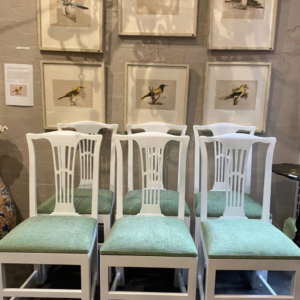
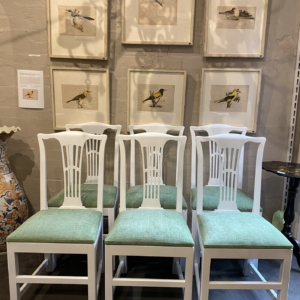
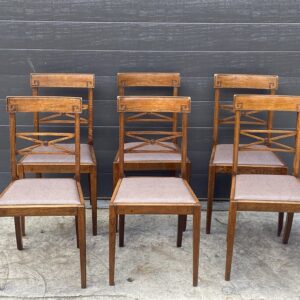
The shaped top rail, above a fret carved tapered centre splat, flanked by shaped tapered uprights.
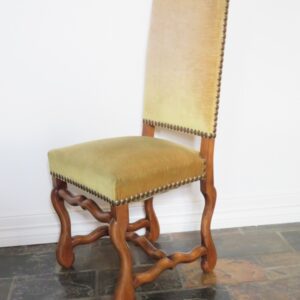
The freshly upholstered soft mint chenille seats blending beautifully.
Resting on a square leg, joined by stretchers.
This set of chairs were very tired, so we cleaned back the surface and refinished them in a soft white.
Would never dream of doing this to a period chair, however this method of restoration has vastly improved these.
These chairs would look fantastic with a period french fruitwood farmhouse table.
The last set I sold through a decorator in 2009.
These chairs also featured in a home I dressed in Elwood 2009.
To see the story of the Elwood home, search ‘Elwood’ on this website.
Above is a one off set of 19th Regency period watercolours of Indian birds, in Kamataka, Southwest India.
Dated 1828
Also, my favourite 17th Century botanical engraver, Hendrick Draakestein 1686.
I sold these to good customers twenty years ago.
They are now moving and need to sell.
I’m always happy to re sell rare items I’ve handled over the past three decades, as they’re so hard to find.
We just finished restoring this fantastic set of 19th century English Country Regency dining chairs.
A customer purchased them not realising that many users ago, someone had drilled holes through every leg and seat rail, tying a coat hanger style metal brace.
Once removed, not easily, they were a complete mess!
Eddie took each chair apart and rebuilt them. We cleaned back, filled the holes, disguised the repairs and refinished them.
Cut back and waxed today and ready to deliver.
I thought I’d share the process with you.
Mixing antiques from different parts of the world can work very well. Not all styles mix well, but 18th and 19th century English and French furniture mixed very well.
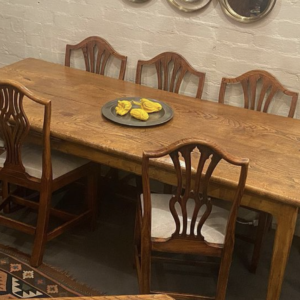
Six from a harlequin set of eight, last quarter 18th century English elm country Hepplewhite dining chairs, with a handsome first quarter 19th century French figured elm, two plank farmhouse table.
Absolutely beautiful. Classic lines with unequalled style, well that’s my opinion.
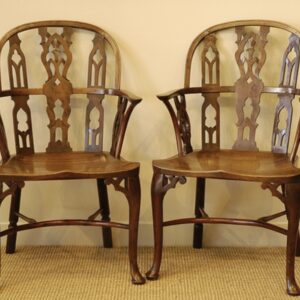
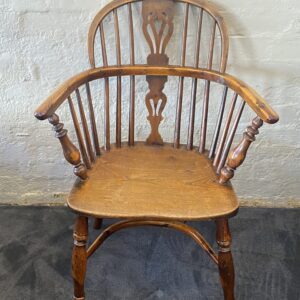
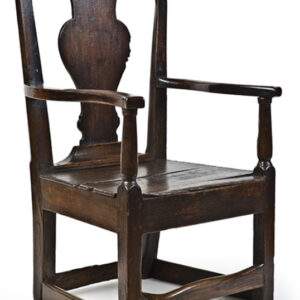
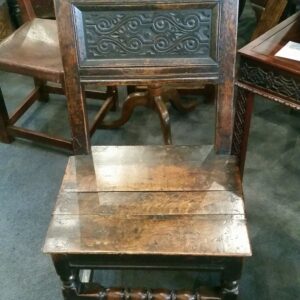
The shaped top rail supporting a large shaped centre splat. The curved arms on turned supports meeting the two plank seat and flowing into a leg. All joined by stretchers. Great 340 year old patina. C.1680
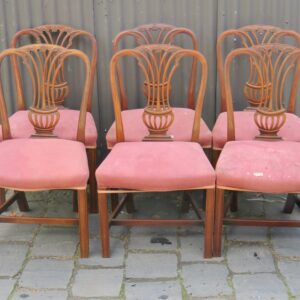
An attractive set of six late 19th Century English mahogany Hepplewhite style dining chairs
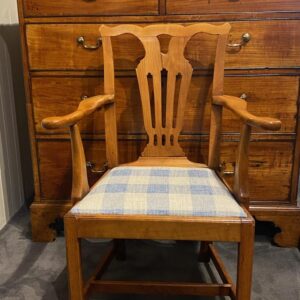
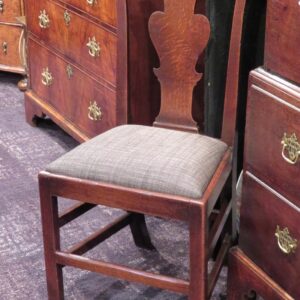
The triple-bowed top rail, having carved flowing leaves following through the joints, into the fine fret-carved vase shaped centre splat, with a comfortable upholstered seat, resting on a square ,serpentine moulded front leg, joined by stretchers.
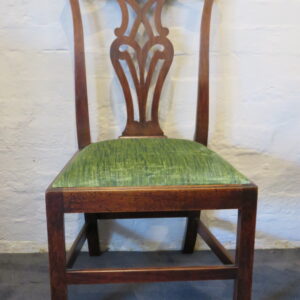
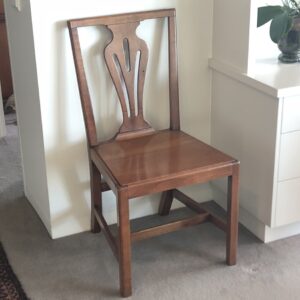
The shaped top rail, having a knot to the centre right, flanked by strong ears,having tapered upright supports framing the well carved vertical centre splat.
The upholstered drop-in seat, inside slight mounlded plain rails, resting on square-block legs, joined by rectangular stretchers.
Perfect overall well faded to a walnut tone patination.
Re selling on consignment. Sold these to Dorothy many years ago. Enjoying having them again and to sell for her now.
A rare pair of Robert “Mouseman” Thompson English oak Arts and Crafts side chairs.
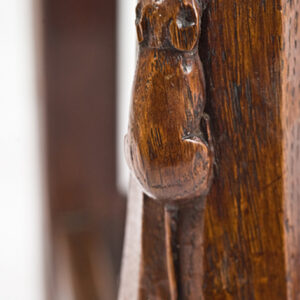
The pollard oak panelled backs above original well patinated leather seats resting on octagonal tapered front legs. Both with the original hard carved mouse.
Robert “Mouseman” Thompson 1876-1955 Kilburn, Yorkshire was a prolific maker of the 1930’s producing traditional handcrafted English oak furniture. He used a mouse as his signature and trademark, hence the nickname.