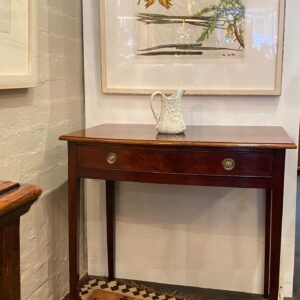
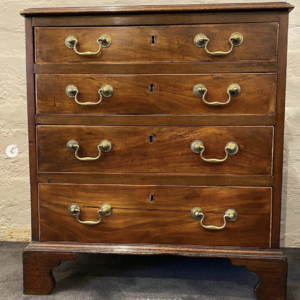
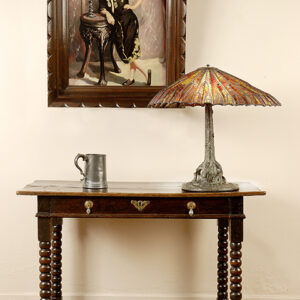
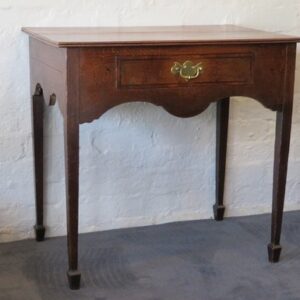
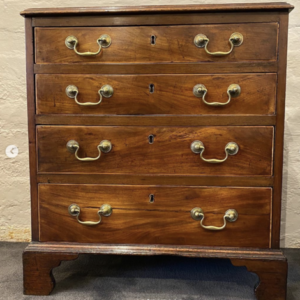
The very well patinated two plank plain moulded top, above one long then two short cock-beaded drawers, retaining the original brass swan-neck handles, resting on square legs.
Good overall color and patination.
This has been our entrance table for the past twenty years.
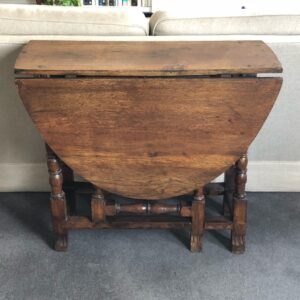
18th Century English George ll faded Mahogany Gate-Leg Table
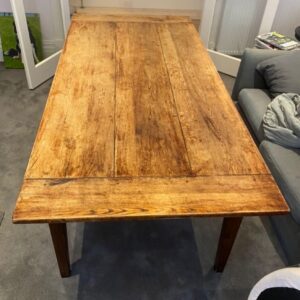
The oval opened three plank top, unusual as usually several joined planks.
Supported by four turned tapered legs, terminating on a round pad-foot.
Good overall faded colour.
Recently restored by Smith & Allpress.
C.1760
These tables are one of Englands best inventions regarding furniture.
Having many different uses.
An attractive sofa/side/hall table.
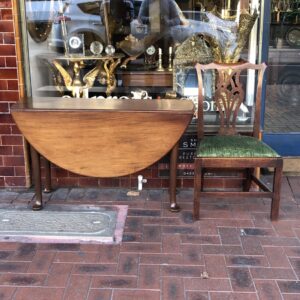
A ‘D’ shaped sofa/serving table. Very useful for entertainers.
Or as a breakfast/dining table.
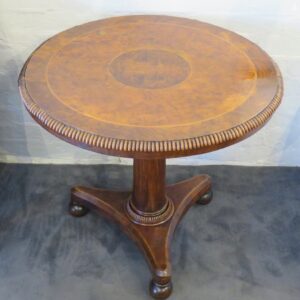
A rare second half 19th Century English Burr Elm, Pollard Oak and Rosewood Wine/centre table.
The Burr Elm, Pollard Oak and Satin-wood banded circular top having a gadrooned moulded edge, resting on a Rosewood gun-barrel shaped column, terminating on the original oak bun feet and low profile brass castors.
A Rare Mid C18th English George II Faded Mahogany Tea Table
AA1841
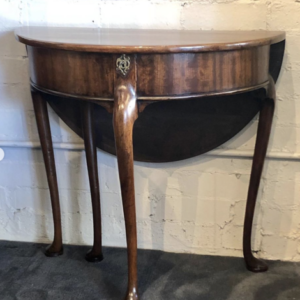
The demilune shaped, hinged top above a deep oval frieze, housing a brass escutcheon and Georgian wire-bow key. Resting on shaped slender cabriole legs, with a rear gate-leg, terminating on pad feet.
The top opening to reveal a deep space where the valuable tea was once locked away from their servants.
The escutcheon, lock and strike plate have been removed over a century ago. We made a faux brass lock case, fitted a suitable escutcheon and added a period wire-bow key.
The rear having a demilune drop leaf and a cabriole gate-leg opening to support the leaf, making a small circular tea table.
These tables are rare. This one had been restored many years ago, we removed the heavy French polish by heavily cutting back and rebuilding a softer wax finish.
Note: all four pad feet have signs of old repairs (as expected) the patina overall is appealing.