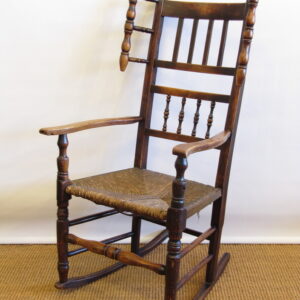
Mid 19th Century English Lancashire ash, elm and fruitwood winged rocking chair. The horizontal elm top rail above four vertical ash rectangular splats then a horizontal fruitwood rail above four turned ash finials fitted to the elm lower support rail. Flanked by ash turned wings attached to the uprights, below are slight shaped ash arms on ash turned supports, with a rush seat having a bold turned front stretcher and narrow turned side and rear stretchers, resting on shaped rockers. Good overall colour and patination.
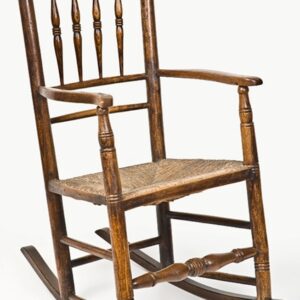
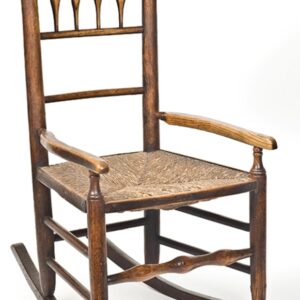
19th Century English ash and beech single row spindle back armchair rocker. The four decoratively turned spindles supported between a plain stay rail and one of two round cross rails. Joined to the round back uprights connected to the curved shaped arms, supported by turned supports, having a rush seat with edge protective strips above turned legs joined by a well turned front stretcher and double side stretchers, on rockers. Attributed to the Westmorland Dales area of the North West.
Dales or single row spindle back ash rocking armchair. Attributed to the North West. Round front legs tapering towards feet to mortice into rockers, joined by turned stretcher, shaped front and double turned side stretchers, below a rush seat. The round back uprights with single row of four decoratively turned spindles, supported between two round curved cross rails with additional cross rail below, curved shaped arms which mortice into the back upright with turned terminal tenons, plain turned underarm supports. Good overall colour and patination.
1800 -1870
Ref – The English Regional Chair, Bernard D. Cotton, Page 335, Figure NW54
Early 19th Century English winged armchair on rockers. A nursing armchair designed for a mother tending her child. The turned wings attached to the uprights were to support cushions and to keep a tired feeding mother upright. The lower arms were also there to allow required elbow room.
An early 19th Century French fruitwood farmhouse table.
The well patinated three plank cleated top above a plain frieze, raised on square section tapering legs. 220 years of great overall colour and patination.
A fantastic coffee table comprising of an early 19th Century French fruitwood dough-bin base with a 19th Century French burr elm quarter panelled door top.
George III English Faded Cuban Mahogany Wine Table
The circular single plank tilt-top having beautiful overall aged and faded patina (Resembling walnut) Resting on a well turned column support, joined to three out-swept cabriole legs, terminating on a pointed pad foot. Stunning!
An attractive early 19th Century French walnut and fruitwood wine table. The book matched 2 plank top on a gun-barrel turned support on high slanted cabriole legs.
Note: Recently arrived from France, still needs leveling, gluing, waxing etc.
A rare 18th Century English mahogany Chippendale carved triple tier games table.
This rare example opens to become four tables. First of all a rectangular side table, secondly opening to a mahogany tea table, next to be a baize toped card table and again opening to a backgammon/chess table, then a lifting lid for cards and other playing equipment.
Note: The triple fork hinges to the tops and the exceptional original carving over all. This rare example should be a museum piece.
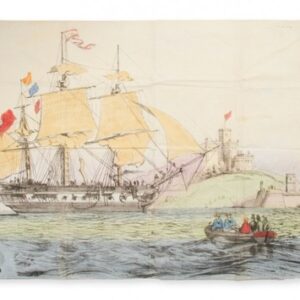
London : The Working Men’s Educational Union, King William Street, n.d. [circa 1860]. Coloured lithograph wall hanging printed on calico, 880 x 1200 mm, the lower left hand corner stamped Working Mens Educational Union. King William St, Trafalgar Square, London, and numbered 123 below; verso with contemporary manuscript caption at upper edge: Australia – arrival at Sydney; original brass eyelets at each corner with original sewn in linen loops for hanging; original fold lines (three horizontal and three vertical); the banner is in a remarkably good state of preservation, the colours still strong and vibrant.
A philanthropic organisation founded in London in 1853, the Working Men’s Educational Union provided free education for the working classes through public lectures at different venues across the city. This wall hanging, which would have been used as part of a display illustrating a lecture on the Antipodes, depicts newly arrived passengers being rowed from ship to shore in Sydney Harbour, with Government House and Fort Macquarie on the right. The immigrant ship is under both sail and steam (the first steam ship to arrive in Sydney was the Sophia Jane in 1831). Although the original artist is unidentified, the graphic is almost certainly after a published lithograph, possibly one which appeared in a journal such as the Illustrated London News. The dress of the passengers in the foreground suggests the original drawing would have been made around 1850.
The National Library of Australia holds twelve similar lithographic wall hangings commissioned by the Working Men’s Educational Union (Rex Nan Kivell Collection, NK801) which illustrate gold mining subjects. However, this particular grand scene of Sydney Harbour appears to be unrecorded.
The Alexander Turnbull Library in New Zealand holds four lithograph wall hangings bearing the Working Men’s Educational Union stamp. These depict scenes titled Panning for gold; Missionary distributing Bibles to Taranaki Maoris; Interior of Otaki Church (after Charles Decimus Barraud), and War dance before the pah of Ohinemutu, near Rotorua Lake (after George French Angas; in turn, after Joseph Jenner Merrett).