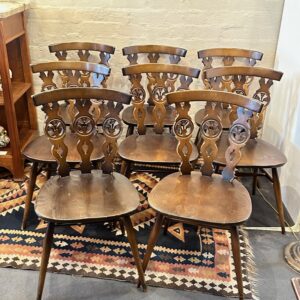
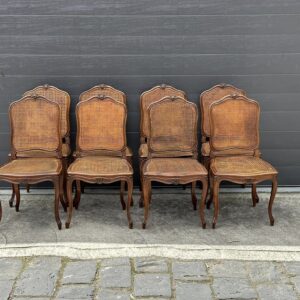
Beech with Elm seats, the bowed top rail above three fret carved Fleur De Lis splats on an elm slight saddle seat resting on fine turned tapered legs,
joined by a high matching H stretcher.
If looking for a comfortable dining chair, these are surprisingly comfortable, well worth coming in to try!
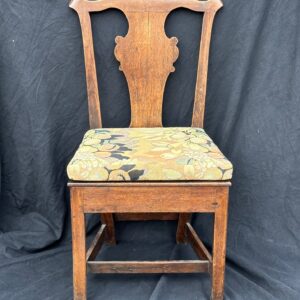
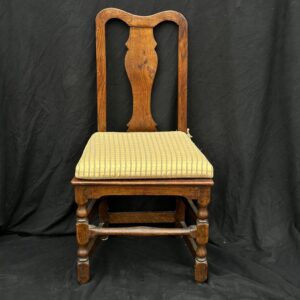
The shaped top rail, terminating in out-swept classic Chippendale ears. The beautifully grained vase shaped central splat, flanked by tapered uprights joined to a two plank seat. With later cushion.
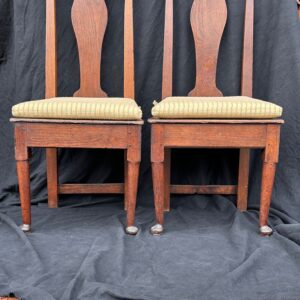
The base having an unusually deep top rail, resting on Queen Anne style turned tapered legs and a bold pad foot.
The central bowed top rail flowing into out-swept ears. The bold shaped central splat, flanked by tapered uprights joined to a two plank seat. With later cushion.
The base with square outer moulded legs, joined by a rectangular “H” stretcher.
C.1770
Good overall colour and patination.
Still in need of re waxing.
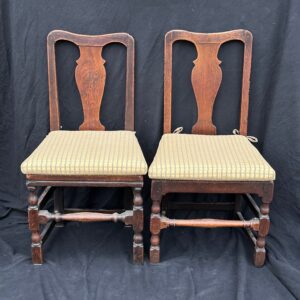
The shaped top rail above a vase shaped upright centre splat.
The base having a moulded plank seat with later cushion, resting on turned, square front legs,
joined by turned front stretcher and twin rectangular side stretchers.
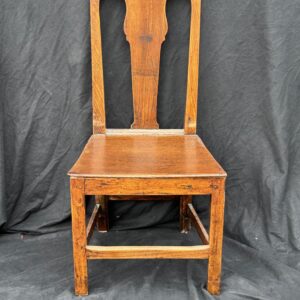
The ogee shaped top rail above a simple scratch-moulded shaped upright centre splat.
The base having a three plank seat with later cushion, resting on turned front legs,
joined by well worn turned front stretcher and twin rectangular side stretchers.
I love how country furniture at times combines several different styles and timbers. Such individuality and uniqueness indeed!
The well patinated four plank cleated top, above a plain skirt, resting on square tapered legs.
Very good overall fade.
Note: the top has a great depth
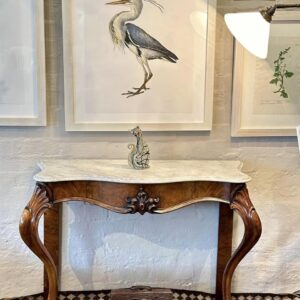
Serpentine shaped moulded marble top, above a matching shaped carved and moulded front skirt, opening to reveal an unexpected narrow drawer.
The stylish lines flowing into acanthus leaf carved knees and over expressed cabriole legs, terminating on a scrolled foot.
The beautifully veneered rear plain rectangular legs, on well shaped moulded feet.
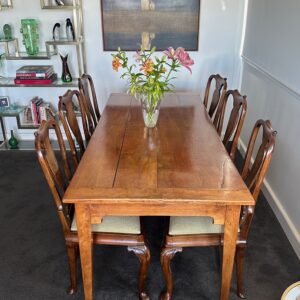
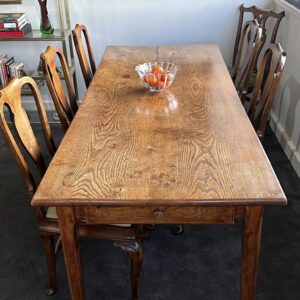
Usually long 3.2m early 19th century French oak refectory/farmhouse table. Having a 6cm thick two plank moulded top.
Above a plain skirt, resting on square chamfered legs, joined by an ‘H’ stretcher.
C.1820
H.78cm W.320cm D.71cm
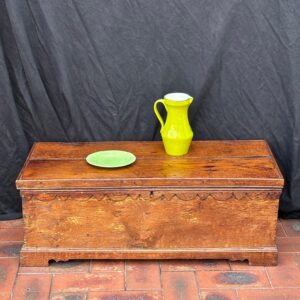
19th century English oak coffer/blanket box.
H.65cm W.138cm D.59cm
The stylish slight shaped pediment, resting on a plain rectangular top rail, with matching side uprights, resting on a mirrored base, and the shortest decoratively shaped bracket feet.
The sectioned panelled sides are so attractive to gaze upon.
The shelved interior having a lower long drawer.
Both central side drawers blocking a matching central sliding panel, with a secret drawer appearing behind.