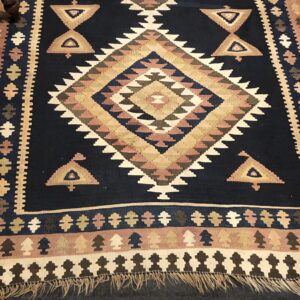

Wide Kilim Hall Rug
‘Ardabil’
North East Iran
Wide Kilim Hall Rug
First half 20th Century
In good sound condition
4.8m x 1.36m
Looking great in my showroom.
$4,500
Showing 209–224 of 424 resultsSorted by latest
‘Ardabil’
North East Iran
Wide Kilim Hall Rug
First half 20th Century
In good sound condition
4.8m x 1.36m
Looking great in my showroom.
$4,500
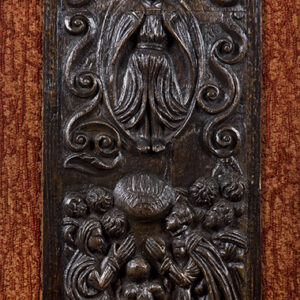
A well carved 16th Century Flemish oak panel of a rising angel with worshippers below.
Note: the top of the panel from the head has a 19th Century replacement.
56 cm x 28 cm (panel only)
19th Century Italian Export Tri-Fold Devotional Cross in Case
H. 18cm
W. 10.5cm
D. 6.5cm
Opened 17.5cm
‘Her Kind’ Solo Exhibition 31.08.11 to 24.09.11
Her Kind explores 19th century Spiritualism and its influence on the mystical renaissance of the 1960’s. Yardley’s small monochromatic paintings are reminiscent of the earliest forms of photography and its reproduction in postcard format. Suggestions of paranormal activity refer to the Spirit photography invented by William Mumler in 1860 where unexpected lights and apparitions of presumed ghosts sit alongside the living sitters. However, rather than appearing in Victorian costume Yardley’s figures resemble the free living characters of the 1960’s; the hippies, beats, nudists and New Agers. The paintings draw on print material and cinema of the 1960’s occult revival exemplified in the films of Kenneth Anger and Roman Polanski. Figures and scenes emerge luminous out of the inky sepia coloured oil paint paying homage to the paintings and etchings of the Symbolists such as Eugene Carriere and Fransisco Goya.
The handle and spouting depicting elephant head and trunk.
H 26cm
W 25cm
By Weber Costello Co. Chicago Heights, Illinois.
I love the steel Art Nouveau stand and the depth of colours to the globe.
Dating this globe is easy, firstly the overall aging and restorations to the globe, then the original Nouveau period stand.
But most interestingly is the names of cities and states around the world in 1925 had been changed.
In 1926 we had ‘Central Australia’ as another state.
This only lasted until 1931.
Constantinople was officially renamed Istanbul in 1930, among other interesting differences.
1925
50 x 30cm
19th Century English Crewel embroidery of parrots and a squirrel within foliage.
Good depth in the colours.
Has not been cleaned in many years.
Applied to a later early 20th Century Australian ash stool.
The stool is still in need of minor restorations, a good clean, light polish and wax finish.
H.30cm
W.97cm
D.30cm
19th Century Chinese Export Chinoiserie Sewing Table
H 70.5cm W 62cm D 42cm
Chic Vintage Pink Glass Vase – Vase en Verre Rose Vintage – France Belgique
H. 50 cm W. 19cm
19th Century Style Anglo Indian Pull Along Horse & Cart Toy
Selling on Consignment
H. 17cm W. 35cm D. 21cm
Pair of 19th Century Ivory Elephant Tusks Originally standing with a gong between
1880 – 1910
L. 72 cm D. 6.5 cm
CWS500
Mali Moir – Epaulette shark (Hemiscyllium ocellatum)
Watercolour on 100% Cotton
1225 cm x 55 cm
$3900
The Epaulette shark (Hemiscyllium ocellatum) is a species of longtailed carpet shark, family Hemiscylliidae, found in shallow, tropical waters off Australia and New Guinea (and possibly elsewhere). The common name of this shark comes from the very large, white-margined black spot behind each pectoral fin, which are reminiscent of military epaulettes. A small species usually under 1 m (3.3 ft) long, the epaulette shark has a slender body with a short head and broad, paddle-shaped paired fins. The caudal peduncle (to which the tail fin is attached) comprises over half the shark’s length. Adults are light brown above, with scattered darker spots and indistinct saddles.
Mali Moir – Maned Wolf
‘Chrysocyon brachyurus’ Maned wolf IUCN Red List -NT’
Charcoal on cotton canvas
114cmH x 134cmW
$7,000
The Maned wolf (Chrysocyon brachyurus) is the largest canid of South America, its long legs are likely an adaptation to the tall grasslands of its native habitat. The Maned wolf is primarily solitary and is not closely related to any other living canid. It is not a fox, wolf, coyote, dog, or jackal, but a distinct canid and is the only species in the genus Chrysocyon. The maned wolf’s evolutionary relationship to other members of the canid family makes it a unique animal and considered the only species among the large South American canids that survived the late Pleistocene extinction. Today it is a rare and protected species. The most significant threat to the survival of the remaining Maned wolf populations is habitat loss, domestic dogs and hunting.
Mali Moir began her career as botanical artist in 1993 at the National Herbarium of Victoria. Combining botanical and horticultural knowledge with artistic skills Mali has contributed pen and ink drawings for Flora of Victoria, Flora of Australia, Mulleria and other scientific publications. By working closely with botanists, Mali has gained an understanding of the importance of scientific accuracy, the fundamentals of precise measurement and thorough depiction of detail. She teaches botanical illustration in association with the Friends of the Royal Botanic Gardens Melbourne, at private art groups and conducts workshops in Victoria, interstate and overseas.
Mali was awarded a Gold Medal by The Royal Horticultural Society London and an invited exhibitor to the Hunt Institute for Botanical Documentation USA. She is recipient of an inaugural Celia Rosser Medal and twice finalist in the Waterhouse Art Prize. Mali was the first Australian to receive the Focus On Nature Purchase Award by New York State Museum USA. She exhibits widely in Australia and internationally and has produced many works for private, public and corporate collections.
Mali has great interest working in the area of conservation and was proud to donate a painting for the charity auction ‘Name a New Species of Shrimp’ held by Australian Marine Conservation Society in association with Museum Victoria, Mali also contributes to ‘Art for Sharks’ with AMCS.
Mali has a keen interest for artistic interpretation of natural history themes in the Accurate Realism style, approaching her work with traditional techniques whilst developing a fresh contemporary look. Mali executes works on paper with the consummate skill of a dedicated artist as she combines her fascination for science and nature with an active desire to render works of art with beauty, character and scientific merit.
Mali abides with her sincere belief that “artists make science visible”.
Mali Moir began her career as botanical artist in 1993 at the National Herbarium of Victoria. Combining botanical and horticultural knowledge with artistic skills Mali has contributed pen and ink drawings for Flora of Victoria, Flora of Australia, Mulleria and other scientific publications. By working closely with botanists, Mali has gained an understanding of the importance of scientific accuracy, the fundamentals of precise measurement and thorough depiction of detail. She teaches botanical illustration in association with the Friends of the Royal Botanic Gardens Melbourne, at private art groups and conducts workshops in Victoria, interstate and overseas.
Mali was awarded a Gold Medal by The Royal Horticultural Society London and an invited exhibitor to the Hunt Institute for Botanical Documentation USA. She is recipient of an inaugural Celia Rosser Medal and twice finalist in the Waterhouse Art Prize. Mali was the first Australian to receive the Focus On Nature Purchase Award by New York State Museum USA. She exhibits widely in Australia and internationally and has produced many works for private, public and corporate collections.
Mali has great interest working in the area of conservation and was proud to donate a painting for the charity auction ‘Name a New Species of Shrimp’ held by Australian Marine Conservation Society in association with Museum Victoria, Mali also contributes to ‘Art for Sharks’ with AMCS.
Mali has a keen interest for artistic interpretation of natural history themes in the Accurate Realism style, approaching her work with traditional techniques whilst developing a fresh contemporary look. Mali executes works on paper with the consummate skill of a dedicated artist as she combines her fascination for science and nature with an active desire to render works of art with beauty, character and scientific merit.
Mali abides with her sincere belief that “artists make science visible”.
Mali Moir began her career as botanical artist in 1993 at the National Herbarium of Victoria. Combining botanical and horticultural knowledge with artistic skills Mali has contributed pen and ink drawings for Flora of Victoria, Flora of Australia, Mulleria and other scientific publications. By working closely with botanists, Mali has gained an understanding of the importance of scientific accuracy, the fundamentals of precise measurement and thorough depiction of detail. She teaches botanical illustration in association with the Friends of the Royal Botanic Gardens Melbourne, at private art groups and conducts workshops in Victoria, interstate and overseas.
Mali was awarded a Gold Medal by The Royal Horticultural Society London and an invited exhibitor to the Hunt Institute for Botanical Documentation USA. She is recipient of an inaugural Celia Rosser Medal and twice finalist in the Waterhouse Art Prize. Mali was the first Australian to receive the Focus On Nature Purchase Award by New York State Museum USA. She exhibits widely in Australia and internationally and has produced many works for private, public and corporate collections.
Mali has great interest working in the area of conservation and was proud to donate a painting for the charity auction ‘Name a New Species of Shrimp’ held by Australian Marine Conservation Society in association with Museum Victoria, Mali also contributes to ‘Art for Sharks’ with AMCS.
Mali has a keen interest for artistic interpretation of natural history themes in the Accurate Realism style, approaching her work with traditional techniques whilst developing a fresh contemporary look. Mali executes works on paper with the consummate skill of a dedicated artist as she combines her fascination for science and nature with an active desire to render works of art with beauty, character and scientific merit.
Mali abides with her sincere belief that “artists make science visible”.