

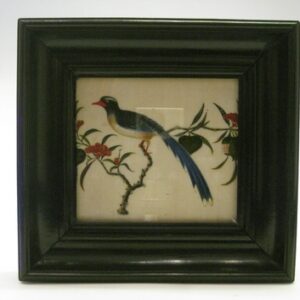
A 19th Century Chinese export framed painting of a bird on rice paper
THIS ITEM HAS BEEN SOLD
A 19th Century Chinese export framed painting of a bird on rice paper
Showing 449–460 of 460 resultsSorted by latest
A 19th Century Chinese export framed painting of a bird on rice paper
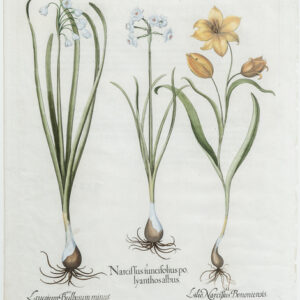
‘Narciflus iuncifolius polyanthosalbus’
Prints by Basil Besler, from Hortus Eystettensis.
Engravings with expert hand colouring.
Some with typical text showing through and minor spots.
Very good condition.
First Edition. 1613
57 cm x 45 cm unframed
Framed: 89 cm x 74 cm
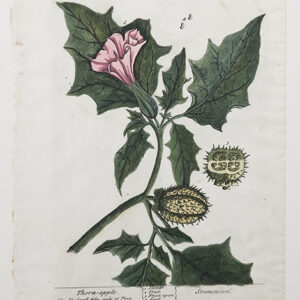
Elizabeth Blackwell (nee Blachrie) was among the first women to achieve fame as a botanical illustrator.
She was born in Aberdeen in about 1700, but moved to London after she married. She undertook an ambitious project to raise money to pay her husband’s debts and release him from debtors’ prison. Her project was a book called A Curious Herbal.
She learned that physicians required a reference book which documented the medicinal qualities of plants and herbs. In order to develop the publication she examined and drew specimens of plants available in the Chelsea Physic Garden. Sir Hans Sloane provided financial support to publish ‘A Curious Herbal’.
Elizabeth Blackwell is notable for being one of the first botanical artists to personally etch and engrave her own designs. This saved the expense of hiring a professional engraver. In total, the enterprise took Blackwell six full years to complete and in the end she was able to release her husband from prison.
A Curious Herbal was published between 1737 and 1739. The book contained the first illustrations of many odd-looking, unknown plants from the New World.
64.5 cm x 51.5 cm
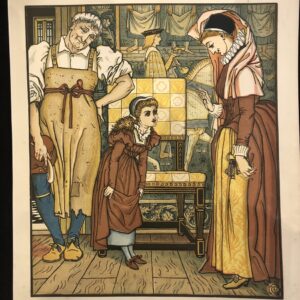
‘Goody Two Shoes’
From the best wood engraver of the 19th century.
Artist-Designer Walter Crane (1845-1915)
Printed and Engraved by Edmund Evans (1826-1905)
Reissue of plates. Medium-wood engraving. Slowly section in colour.
Type of wood engraving- Chromoxylography.
Walter Cranes initial in each plate.
Goody Two Shoes, Aladdin & The Yellow Dwarf.
Extremely rare.
28x23cm – 45x27cm
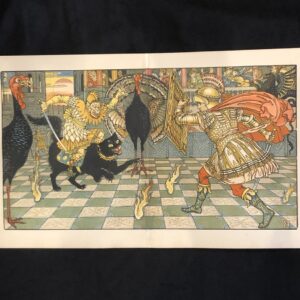
From the best wood engraver of the 19th century.
Artist-Designer Walter Crane (1845-1915)
Printed and Engraved by Edmund Evans (1826-1905)
Reissue of plates. Medium-wood engraving. Slowly section in colour.
Type of wood engraving- Chromoxylography.
Walter Cranes initial in each plate.
Goody Two Shoes, Aladdin & The Yellow Dwarf.
Extremely rare.
28x23cm – 45x27cm
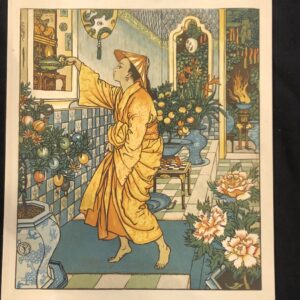
‘Aladdin’
Artist-Designer Walter Crane (1845-1915)
Printed and Engraved by Edmund Evans (1826-1905)
Reissue of plates. Medium-wood engraving. Slowly section in colour.
Type of wood engraving- Chromoxylography.
Walter Cranes initial in each plate.
Goody Two Shoes, Aladdin & The Yellow Dwarf.
Extremely rare.
28x23cm – 45x27cm
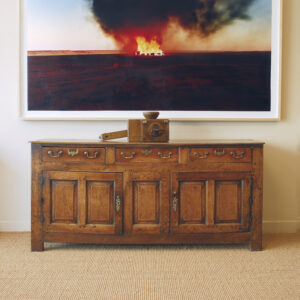
Rosemary Laing Burning Ayer #6, 2003 Type C Photograph 110.0 x 224.0 cm number 6 from an edition of 10
Provenance Private collection, Melbourne Exhibited ‘one dozen unnatural disasters in the Australian Landscape (part 1), Gitte Weise Gallery, Sydney, 2003 ‘‘The unquiet landscapes of Rosemary Laing’, Museum of Contemporary Art, Sydney, 23 March-5 June 2005
Illustrated This work has been illustrated and the series has been written about extensively including: ‘The unquiet landscapes of Rosemary Laing’, Museum of Contemporary Art, Sydney, 2005, illus. p.62-63 Abigail Solomon-Godeau, ‘Rosemary Laing’, Piper Press, Sydney, 2012, illus. p.131
‘For Laing, one’s place as a white Australian artist is inescapably a locus of contradiction and difficulty insofar as the indigenous people have historically been displaced. Or replaced. We find her work is always provisional, tactful, and a self-conscious investigation of her own imperfect belonging to homeland.’ (A.Solomon Godeau, Rosemary Laing, Piper Press, 2012, p. 28)
This is a climactic scene from the series ‘one dozen unnatural disasters in the Australian landscape’ 2003. In the series, spectacularly staged ‘disasters’ disrupt majestic landscape panoramas and Laing’s interventions recast the acts of invasion and colonisation as unnatural disasters; emphatic opposites to natural disasters like bushfire or flood.
The mesmerising image of flames pouring upward from Wirrimanu country near Balgo in Western Australia, has been made in the image of Uluru, with the sacred monolith fashioned from IKEA furniture powder coated in the red desert sand. The funerary pyre of a would-be Ayer’s Rock hints at disaster beyond itself.
Burning Ayer #6 riffs on the postcard trade that promotes Uluru as the essential, ancient Australia to throngs of tourist crowds. Laing takes aim at this sort of de-contextualised, pristine scenic photography that nullifies the contentious history of the site.
Godeau has said that ‘even in her deployment of a medium that freezes time forever, (Laing’s artworks) are concerned with critically mobilising the history of the present.’ So intricately researched, planned and executed are her images that the photographs represent one facet of a much larger sociological process at work beyond the picture plane.
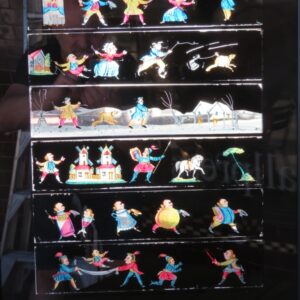
A collection of 19th Century glass cartoons – Recently reframed into a pair.
Very rare with stunning colour.
W. 44cm H. 56cm – Framed
W. 30cm H. 7cm – individual
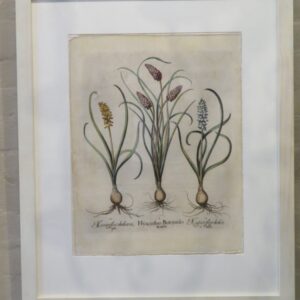
Besler – ‘Hyacinthus Botryoides’
Prints by Basil Besler, from Hortus Eystettensis.
Engravings with expert hand colouring.
Some with typical text showing through and minor spots.
Very good condition.
First Edition 1613
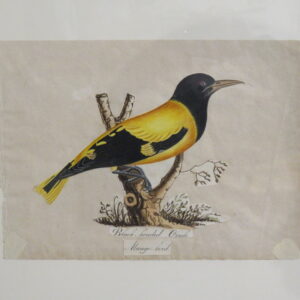
Nineteen exquisite ornithological subjects, painted by a visitor to the sub-continent in the 1820’s. The representations are anatomically correct and accurate in scale, yet all of these finely executed watercolours – by an unknown but clearly gifted artist – manage to display strong individual character, painstakingly cut as silhouettes and laid down on eleven contemporary folio album pages (510 x 290 mm each) in the style of decoupage, all but three of the specimens with an accompanying contemporary manuscript label cut and pasted onto the page beside it, all the illustrations in an excellent state of preservation, the colours still vibrant, the paper stable, some residual tape marks to corners and margins of the sheets which do not detract, one of the captions identifying a location (Bellary, in Karnataka, southwest India) and a date (January 1828).
The manuscript labels read as follows:
Black-headed Oriole Mango bird. Lark. Alanda sp. The birds appear in October in immense flocks and depart in March – often mistaken for Ortolans.Plover. Water Wagtail. Eagle. Shot at Bellany Jan 1828. Breadth from Wing to Wing 6 feet. Half size. Falco Sp. Chysactos. Spur Foul: Tetrao sp. Partridge. Short tail Tern. Water Wagtail. Bansputtah or Bamboo Frequenter. Common Florican. Stone Chat. Malacilla Rubicola. Three-toed Quail (male and female). Golden Oriole. Female. Golden Oriole. Male. Grey Shrike. Female. Lanius Sinerius.
Framed by Vicki Hutchins.
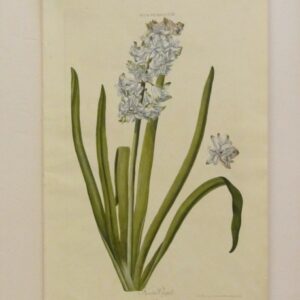
Hyacinthus VIII “Hortvs, Nitdissimis Omnem Per Nnvm Svperbiens/Floribvs”
Published by Cristoph Jacob Trew in Nuremberg. Copper engraving with original hand colour.
1750 – 1786
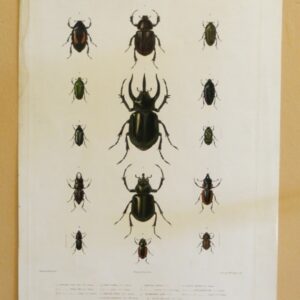
Natural History – Dumond D’ Urville
Insectes Coleopetres by C.E. Blanchard
Hand coloured steel engravings of beetle specimens from Ambon (Moluccas), New Zealand and Tonga. Single folio sheet, plate size 400 x 270 mm, drawn by Blanchard, engraved by Mme Egasse, printed by Gide; being Plate 9 from the Atlas volume of Dumont d’Urville’s Voyage au Pole Sud et dans I’Oceanie sur les Corvettes I’Astrolabe et la Zelee, pendant les annees, 1837-40 (Paris’ Hombron et Jacquinot, 1842).
Mild water stain to upper left margin, not affecting the plate, which is in fine condition.
Unframed 31.5 cm x 51 cm