
Showing 65–80 of 463 resultsSorted by latest
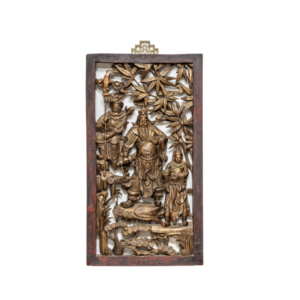
A rare 19th century Qing Dynasty gold leaf carved hanging panel of three Chinese gods.
Surrounded by foliage.
Carved entirely from one piece of wood.
A private purchase from some time ago.
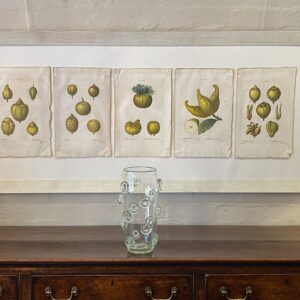
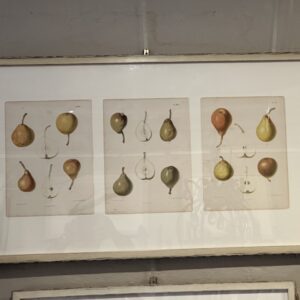
Redouté – A decorative framed arrangement of five early 19th Century hand coloured citrus engravings.
These wonderful rare hand coloured copper engravings hung in my home for many years.
Now too wide to fit into my apartment, I’m selling.
1830 H.77cm W.175cm
Photography by Russell Winnell Photography
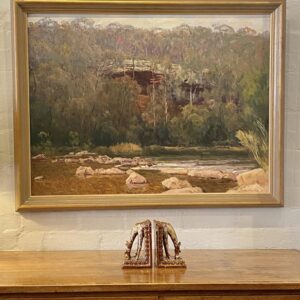
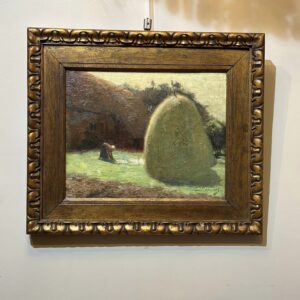
‘Upper reaches of the Avon River Gippsland’
Continually changing art around in my apartment.
Today I added Mali Moir’s ‘Cape Warthog’ moving Lucinda Chambers ‘Long Distance Love’
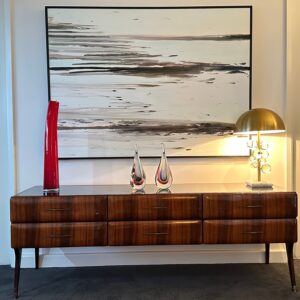
above the Italian retro rosewood sideboard.
I’m also trying Martin Tighe’s ‘Still Water’
Keeping Lydia Ciconte’s ‘Bush Fire Burning’ in the entrance, above the mid 18th century
English oak low dresser.
Looking forward to Russell Winnell photographing all when completed very soon…
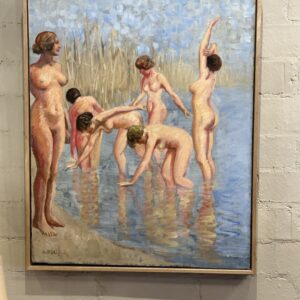
‘Bathers’ Oil by Gustav Michael Pillig
Oil on canvas
Group of Females Bathing Nude
67x51cm
Gustav Michael Pillig
1877 Gelsenkirchen – 1956 Melbourne
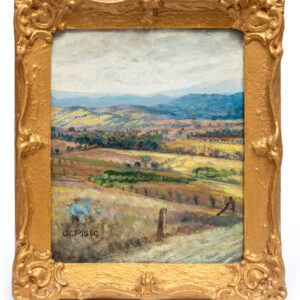
Countryside Landscape Oil by Gustav Michael Pillig
Oil on board
29x24cm
Gustav Michael Pillig
1877 Gelsenkirchen – 1956 Melbourne
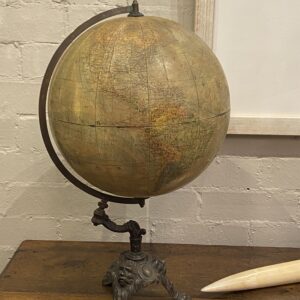
Restoration of German Terrestrial Globe
Taking apart, removing old glues, packing the interior for stability, re-glueing and holding glues together.
Then watercoloring the damages out.
Wonderful outcome.
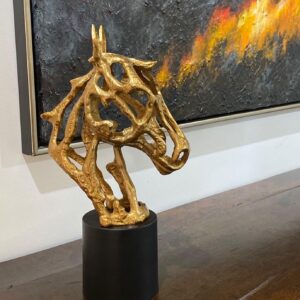
Unusual contemporary brass sculptured horse head on stand
I purchased this unusual sculpture from a supplier recently.
I’ve featured in a display and taken home to play with.
This morning I’ve ordered two more to sell, as I’m keeping this one!
DM me for pricing.
H.44cm
W.12cm
D.22cm
‘The Gatherer’ Oil on Canvas. 107x101cm
A decorative antiqued visual montage of the artists favourite objects.
The pretty girl has gathered a pomegranate and auricula flower from the display.
Inspired by 18th – 19th century New England naive portraiture art.
In foreground
Auricula flowers in full bloom
A wooden jardinier with overflowing magnolias
A delftware blue and white urn and pomegranates.
Finished with an antiqued glaze.
107 x 101 cm
Oil on canvas 2022
Below,
An unusual 19th Century French Fruitwood, Burr Elm and Oak Dough bin
Resting on a Wide Kilim Hall Rug. ‘Ardabil’
North East Iran
Wide Kilim Hall Rug
First half 20th Century
In good sound condition
4.8m x 1.36m
Unusually large 18th Century blue and white,
Dr Wall Worcester jug.
I purchased this privately over 30 years ago. I’ve had in my private collection and used in many displays and advertisements over the years.
A decorative 19th century English acanthus leaf styled stoneware jug.
Unusually large 19th century Masons Ironstone mug (my private collection)
Early 19th century English Masons Ironstone jug.
Dated 1813.
Three bright, attractive Sunflower paintings
Recently found these three Sunflower paintings in my storeroom.
Reasonably priced to move on..
80 x 80cm
59 x 49cm
50 x 60cm
Visiting Customers over Easter
I visited nearby customers today, to see the framing Vicki Hutchins
did for the three 18th century Elizabeth Blackwells I sold them.
While there I enjoyed some of their other pieces, including the decorative
18th century French walnut panetiere and petrin/dough bin/jardinier.
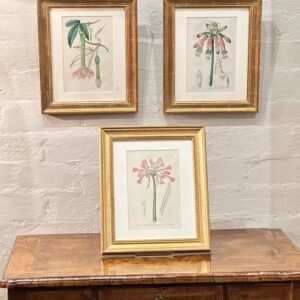
Three beautiful Botanicals, newly framed.
Elizabeth Blackwell (nee Blachrie) was among the first women to achieve fame as a botanical illustrator.
She was born in Aberdeen in about 1700, but moved to London after she married. She undertook an ambitious project to raise money to pay her husband’s debts and release him from debtors’ prison.
Her project was a book called ‘A Curious Herbal’.
She learned that physicians required a reference book which documented the medicinal qualities of plants and herbs. In order to develop the publication she examined and drew specimens of plants available in the Chelsea Physic Garden. Sir Hans Sloane provided financial support to publish ‘A Curious Herbal’.
Elizabeth Blackwell is notable for being one of the first botanical artists to personally etch and engrave her own designs. This saved the expense of hiring a professional engraver. In total, the enterprise took Blackwell six full years to complete and in the end she was able to release her husband from prison. ‘A Curious Herbal’ was published between 1737 and 1739.
The book contained the first illustrations of many odd-looking, unknown plants from the New World.
1686 – 1986
Notice how even a retro made semi Chippendale style dining chair can match so well with a striking piece of art 300 years older.
Contemporary framing can completely change the look of a copper engraving, painting, lithograph, even old photos. It’s not hard.
These chairs were unattractive, dark and had shocking patterned upholstery.
Once again, it’s not too hard to improve a chair.
I have these in a window display this week.
Quite eye catching, along with the descriptions of both.
As always it’s important to create interesting window displays
Draakestein Collection – Hortus Indicus Malabaricus 1686
Hortus Indicus Malabaricus by Hendrik Draakestein 1686.
The first complete flora from the East Indies. A very fine example of copper engraving.
My favourite botanical master of the 16th, 17th, 18th and 19th centuries.
1686 ‘Hortus Indicus’ was published in Amsterdam.
A Rare pair of Early 18th Century English Copper Engravings of Grand English Estates
By Jan Kip and Leonard Knyff
1720
57 x 70cm
Johannes “Jan” Kip Amsterdam 1652 – 1722
Jan Kip was a Dutch draftsman, engraver and print dealer.
Kip and Leonard Knyff, made a speciality of engraved aerial views of English country houses and estates.
Personally, I find his work astounding and so ahead of his time.
Kip remains my favourite of all architectural artists.
*Maison du Seigneur
*Burlington House Pickadilly
Kip was a pupil of Bastiaen Stopendaal (1636–1707), from 1668 to 1670, before setting up on his own; his earliest dated engravings are from 1672. In April 1680, at the age of 27, he married Elisabeth Breda in Amsterdam.[1] After producing works for the court of William of Orange in Amsterdam, Kip followed William and Mary to London and settled in St. John Street in Farringdon, where he conducted a thriving printselling business. He also worked for various London publishers producing engravings after such artists as Francis Barlow (c. 1626–1704) and Caius Gabriel Cibber (1630–1700), largely for book illustrations. He made several engraved plates for Awnsham & John Churchill’s A Collection of Voyages & Travels (first published 1704). He signed the African scenes in volume V of the 1732 edition as “J. Kip”.
His most important works were the large fold-out folio illustrations for Britannia Illustrata, 1708; for the 65 folio plates he engraved for the antiquary Sir Robert Atkyns, The Ancient and Present State of Glostershire, 1712 (1st edition); and for Le Nouveau Théâtre de la Grande Bretagne ou description exacte des palais de la Reine, et des Maisons les plus considerables des des Seigneurs & des Gentilshommes de la Grande Bretagne, 1715, an extended reprint in collaboration with other artists.
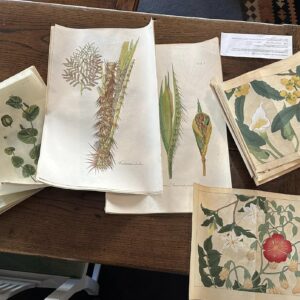
Draakestein – A collection of 15 unframed prints – Hortus Indicus Malabaricus – 1686
Hortus Indicus Malabaricus by Hendrik Draakestein
The first complete flora from the East Indies. A very fine example of copper engraving.
My favourite botanical master of the 16th, 17th, 18th and 19th centuries.
1686 ‘Hortus Indicus’ was published in Amsterdam.
To me, he was the master. Posted are several of his more attractive florals.
My showroom always boasts at least six Draakestein’s.
Also, in my apartment I have one, but once completed hanging, I’m sure I’ll place at least one more.
On top of his distinctive style, he wrote the name of each subject to the top right of each page in, Latin, Malaysian, Indian and Arabic.
Truly fascinating.
Hortus Indicus Malabaricus by Hendrik Draakestein
46 x 38 cm (unframed)
CGW381539-7