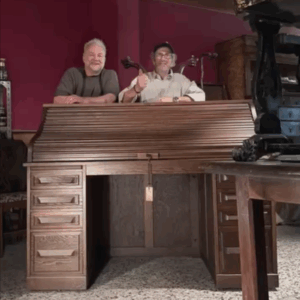
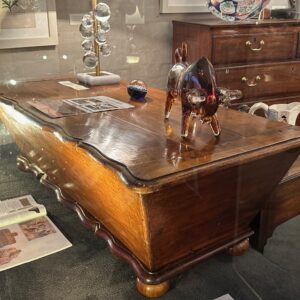
Hadn’t restored one myself since the early 90s, when they were selling between $5,000 – $9,000, remarkable!
We restored this for a customer I’ve been doing business with for a many years. I helped re furnish and re style her Mothers room at Mecwacare Malvern, great memories ✨
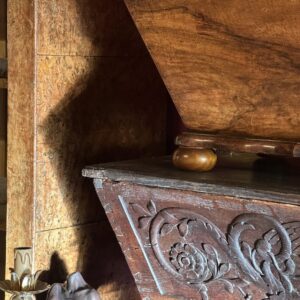
Sadly I didn’t take any before photos, just a few parts of. You’ll notice the thick dark varnished surface. Took three coats of paint stripper!!!
The piece needed a lot of repairing and re gluing. Also the stripper dissolved what was left of the fabric holding the roll top together. Anyway after all the work, Eddie and I are very satisfied with the end result.
This desk was dated 1914. Started out its life in her family and has been handed down from great grandfather, grandfather to father, now to her son, who will enjoy this beauty for the rest of his life.
One thing about roll top desks, they hold a lot of documents and files. Very functional. They also have a very clever locking system (that we also had to repair) once locked, quite impossible to enter, now will last another 100 years…
Very happy customers ✨
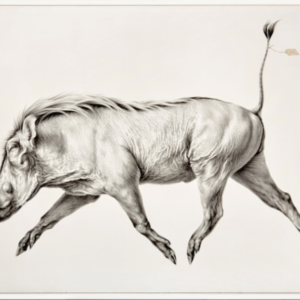
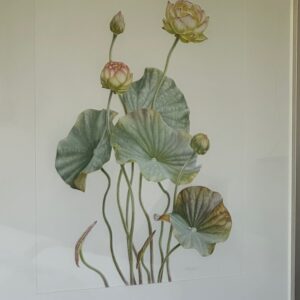
My friend Mali Moir produced these masterpieces in 2017 and had The Metro Gallery representing her.
I was at the opening with a few close friends, was a great evening.
Prior to the opening I had been in re dressing Dee and Peter’s beautiful homes walls. I had the pleasure seeing Mali create these in her home, so when I saw their wall space, I already knew which two would be perfect, so SOLD!
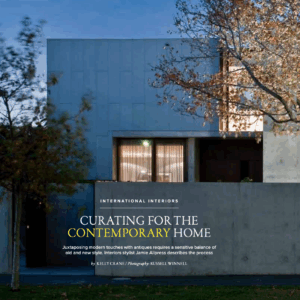
In 2015 Jola from Luxurysqft magazine, Dubai contacted me regarding a story Kelly Crane wanted to write about my styling of several properties she had viewed on my website.
I was quite flattered, so agreed. She particularly liked my friends home I’d recently re dressed in Brighton, Victoria, so these are the photos she chose and the story written.
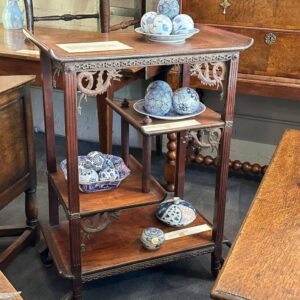
Rare 19th century French solid kingwood ‘whatnot’
This rare 19th century French solid kingwood whatnot is certainly a work of cabinetmaker, leader of Japonism, Gabriel Viardot (1830-1904).
It is surmounted by a varnished polished bronze dragon that is frequently found in the cabinetmaker’s production.
The lower part also has shelves whose upright is decorated with a wrapped dragon in varnished polished bronze.
H.98cm W.69cm D.40cm
Now with the remaining of my stock, in storage awaiting a pop up shop somewhere around Australia.
Or you’re welcome to visit my storeroom/workshop inner city Melbourne.
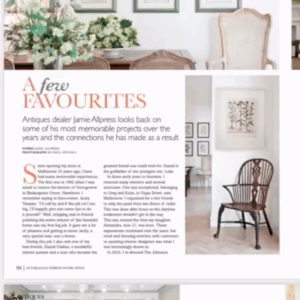
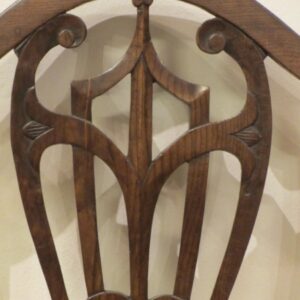
The Hepplewhite style bowed back rail, with plain shaped upright arms, resting on corner moulded square block legs, joined by a matching front stretcher and central ‘H’ stretcher.
The Botanical Magazine; or Flower-Garden Displayed, is an illustrated publication which began in 1787.
The longest running botanical magazine, it is widely referred to by the subsequent name Curtis’s Botanical Magazine.
Each of the issues contains a description, in formal yet accessible language, and is renowned for featuring the work of two centuries of botanical illustrators
Many plants received their first publication on the pages, and the description given was enhanced by the keenly detailed illustrations.
Even the portrait hanging, I remember was selling for Bryan Collie, Melbourne Fine Art Gallery, a very supportive business and personal friend right from the start 1990.
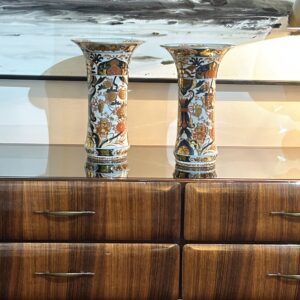
Actually I was selling the buffet decor for another great friend that taught me so much for many years.
So many great memories over the past 3.5 decades.
Including my friend David Glyn Davies painting the Celtic scroll on my shop wall. Clearly visible in my ads throughout the 90s.