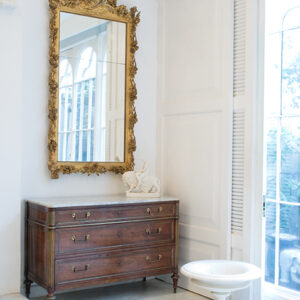
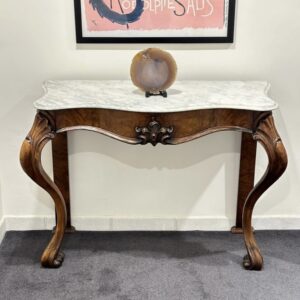
Serpentine shaped moulded marble top, above a matching shaped carved and moulded front skirt, opening to reveal an unexpected narrow drawer.
The stylish lines flowing into acanthus leaf carved knees and over expressed cabriole legs, terminating on a scrolled foot. The beautifully veneered rear plain rectangular legs, on well shaped moulded feet.
Fantastic overall well faded original polished and waxed patina. Could I have raved anymore? What a piece!
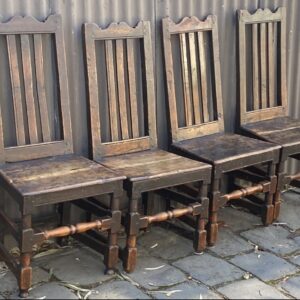
A pair of late 17th Century oak side chairs, North West England.
Each with rectangular scroll carved panelled back with scroll cut and guilloche, carved cresting embraced by pyramid finial surmounted uprights, solid seat on block and turned supports. Jointed by a turned front stretcher and multiple side stretchers.
ALLPRESS ANTIQUES @ MELBOURNE – THE PAST FOUNDING THE FUTURE
‘Antiques are timeless classics that look wonderful in contemporary settings’*
Gaining and enjoying a sensitivity to a timeless design aesthetic has been part of the passionate life journey of New Zealand born Melbourne based antiques dealer Jamie Allpress. It began when he was only 11 years of age, working after school in an antique shop in the beautiful surroundings at Dunedin in New Zealand. It is also where he first learned the skill of maintaining original finishes, hand graining, colouring and wax finishing as he embraced the concepts of conservation and restoration of fine furniture.
An outstanding and rare late 17th Century Oak and Elm primitive Windsor armchair – Wales. The slanted upright plank back slotted through the single plank bowed arm on four bobbin turned supports joined to the elm saddle seat raised by four tapered out swept legs. Dated 1697 with the initials later gouged out and showing signs of very old repairs including shaped iron braces applied by hand made nails.
Note: This chair is worthy of a museum and will probably never leave my personal collection. I have had the chair photographed in complete detail to display on my website and to be included in a future publication.
Sat in our dining room corner, appearing like a sculpture for many years, now sits in my apartment bedroom ✨
Paying attention to the overall beauty of the rare pieces I’ve sold is one of my more enjoyable pastimes. Finding that unseen knot to the grain of one of the solid oak rear planks, or to the inside of a square tapered leg of a farmhouse table (upcoming post),
Or the small section of sap-wood on the oak dresser base, riddled with long gone borer holes, always to me a great find. These little unseen touches to a piece really excite me.
I do find it a little sad that probably nobody else has ever noticed and missed out on immense pleasure I get from discovering these unique touches.
Yet another wonderful thing of dealing in country furniture, that unlike “town” pieces, a lot more perfect and certainly no place for a huge knot or a fallen knot making the timber imperfect and therefore unusable, so would be cut up to be used as corner blocks. With country or provincial pieces, these imperfections were overlooked, usually as good timber’s were scarce and they used whatever they had.
I’m sort of writing ahead for the upcoming story, but this also relates to this piece.
The 1940s Paris newspapers stuck to the backboards, ads yet another interesting touch to this rare 18th Century French Oak Buffet Deux Corps, of Small Proportions
This is French with strong English Hepplewhite influences. ref to my website, Furniture, French, Buffets.
Such an interesting piece.
Included on my Retirement SALE,
$16,500 reduced to $8,250
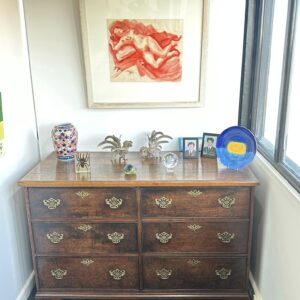
The two plank moulded top, above brass handled, two short and one long drawer, with a slight ogee-shaped skirt, resting on stylish cabriole legs, terminating on a round pad-foot.
H.70cm W.81cm D.50cm
C.1880
18th century English cream wear Thomas Whieldon-type tortoiseshell.
Purchased this table in Chester,
UK over 15 years ago, finally re-glued and wax finished.
UK1899
The plain well faded medullary ray grained four plank tilt top above a bold turned column, resting on elegant out swept legs.
Circa 1790
H. 69cm Dia. 79cm
$4,400 reduced to $2,200
Retirement SALE for one final year, all stock reduced from 50 – 60%
I can’t take it with me!
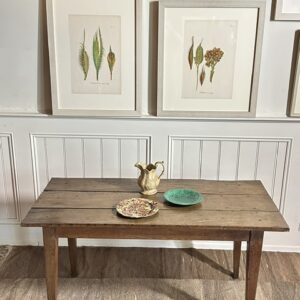
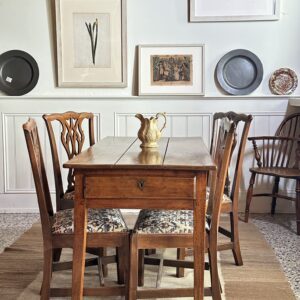
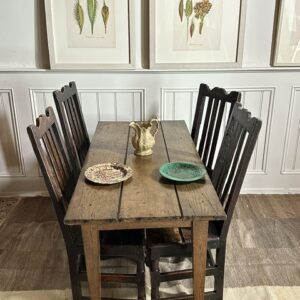
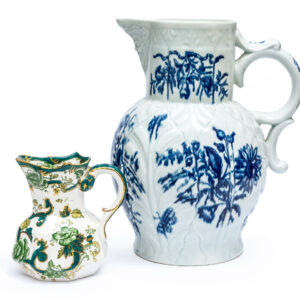
19th century English stoneware jugs and 19th century green majolica plate.
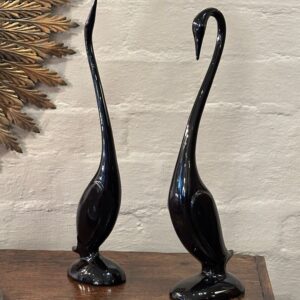
Contemporary brass copy of a classic horse head sculpture on cylindrical stand.
I saw an interesting story on researching the age of timber yesterday on Logan and Angelina’s @ourdollarhouse. Made me think of a few pieces I’ve sold and still have. This is a short story on the age of some rare pieces.
Being a semi retired antique and art dealer, specialising in furniture from that 16th – 20th century, I’ve had many pieces between 500 – 300 years old. Coming to mind,
One outstanding early 16th century Flemish oak credence table from 1520.
A small first half 17th century English oak livery cupboard 1600 – 1640
(both sold to the same Western District family)
an early to mid 17th century English oak refectory table 1600 – 1650, the thick removable cleated top, one single plank! Also graffitied T.A.S. 19/7/13, could’ve been scratched 1713 or 1813, I’d say 1713, due to the soft worn edges.
Truly amazing having this history in my hands. Actually, I recently bought that table back after selling to a friend 25 years ago!
I also sell art from 14th – 20th centuries. I have several large unused pages from a book of hand coloured copper engravings from 1686, actually by Hendrick Draakestein, how’s that for history. So the oak tree used for that 1520 credence table would have been at least 150 years old, so planted at least 1380. The wide plank of ok on the refectory table planted at least 1500.
Looks like we share a deep passion for history and timbers.
I also mentioned the 17th century paper I have from a book of botanical art by Hendrick Draakestein 1686, wonderful to have.
20th century Australian Regal Mashman drip glazed display bowl. Beautiful lines.
Also my personal small collection of Drip Glazed, Australian Deco Regal Mashman pottery. Always loved them.
18th century English George III country oak low standing chest of drawers.
SOLD chest and collection in my closing sale.
Finding an original pair is near impossible, so locating a near match is also rare.
I’ll only sell these together.
Reduced to $4,500 pair.
A rare George III Cuban mahogany folding tea table.
The exquisite grained single plank rectangular moulded top, lifting to become a two plank square tea/card table top.
The unusual centered hinged rear legs opening to join with the sides.
The beautifully moulded front legs give a sense of style to a very classic straight lined table.
The narrow cock beaded drawer to the plain skirt, retaining the original brass swan-neck handle.
C.1770
H.72cm W.86cm D.42cm
Opened 84x86cm
Last quarter 18th century English tea/card table.
The single plank well faded hinged folding top, opening to a tea serving or card playing top.
Having a figured mahogany frieze with narrow card holding drawer, retaining the original brass swan-neck handle.
Resting on square tapered ogee-moulded legs. One hinged rear leg, supports top when in use.
Note: rarely are the opened tops as well faded as the closed. Indicates was very well used and loved.
C.1780
H.72cm W.90cm D.44.5cm, opened 89cm square.
The moulded top rail,
with carved scrolled ears, above a vase-shaped center splat, flanked by serpentine shaped side supports.
The upholstered drop in seat, resting within narrow thumb moulded, book-matched rails, resting on well carved scrolled cabriole legs, with a round pad-foot.