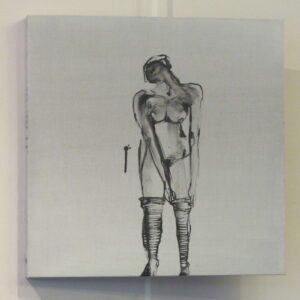
There are no obstacles in Carmel Jenkin’s work. Her nudes are for: ‘getting emotion out there’ . To achieve this, she brings the nude right up to the picture plane, to directly involve the viewer with the subject. While there is an element of abstraction in her work, the female ambience, as if the artist’s eye got so close she could see the nude as emotion in a series of curved shapes. These works are raw and immediate and usually have a distorted and linear form. They may portray a sense of naked angst but, at the same time, show possession of a deeply spiritual soul. At the risk of exclusionism one wonders if these works, drawn by a woman, are a language to be read and pondered by other women. Either way, Carmel Jenkin is engaged in a passionate journey of artistic and life discovery through the female body.
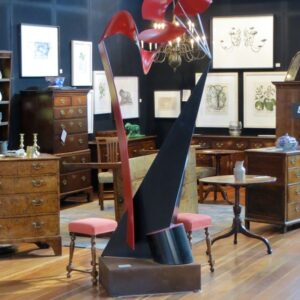
Robert Hague has been a practicing sculptor for over three decades and during his career he has participated in solo and group exhibitions in Australia, New Zealand, China, Hong Kong and the United Kingdom. Robert was born in Rotorua, New Zealand and re-located to Australia in the mid-1980s.
In 1999 he was awarded ‘The Director’s Prize’ in Sculpture By The Sea, Sydney. In 2000 he received the ‘Waverley Art Prize’ for Sculpture Sydney, and in 2010 he won the Deakin University Contemporary Small Sculpture Award. Robert’s sculptural work is part of corporate and private collections in Australia, China, New Zealand, United Kingdom and the United States.
Robert is based in Melbourne working primarily with bronze and steel. He is fascinated by the radical asymmetry of his work, one that forces continued change in the work through rotation. He sees it as a revelation in the making that is constantly challenging his ways of creative thinking.
This work was inspired by a conversation with an American sculptor, about rotational symmetry. ‘I had argued against symmetry but decided to experiment with rotation after his comments on repetition’. In particular to the Orbis series, the internal cuts make reference to the Maori wood carvings he grew up amongst in Rotorua, New Zealand.
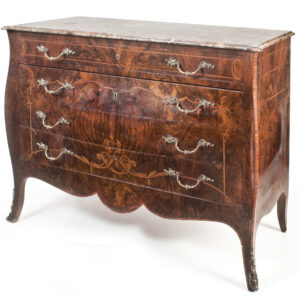
Stunning late 19th Century French book-matched figured walnut and beautifully inlaid commode. Having the most beautiful original moulded marble top, above the slight bombe shaped drawer front. Having beautifully book-matched rich figured walnut veneers with flowing satinwood floral shaped inlays overall.
Note: matching sides.
The shaped lower frieze flowing into the high splayed legs, having narrow kingwood cross, banded to all outer edges. Having all of the original ormolu brass-work.
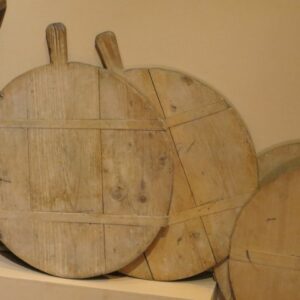
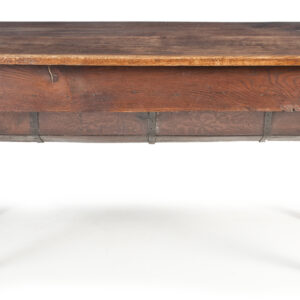
First half 19th Century French oak dough bin. The rectangular hinged top above a deep plain frieze housing barrel shaped storage, resting on bold square tapered legs.
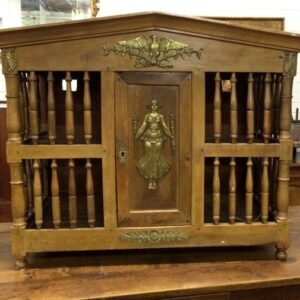
A beautiful first half 19th Century French fruitwood hanging Panetiere,
Built in the classic Greek coloseum style, having exceptional and unusual decorative brasswork attached, including a stunning Greek Goddess holding two torcheres of life and an eagle above to watch over and protect her.
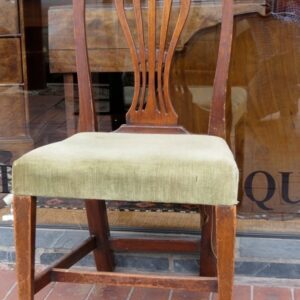
The bowed top rail above a fret carved vase centre splat and waisted side supports on an upholstered seat, square tapered legs terminating in moulded capitols joined by a centre ‘H’ stretcher (Note: These chairs need the later coloured varnish carefully removed and refinished and waxed to show the real beauty).
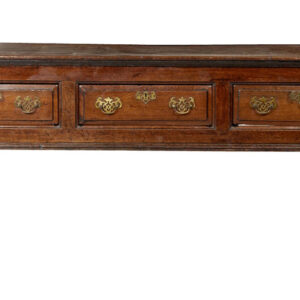
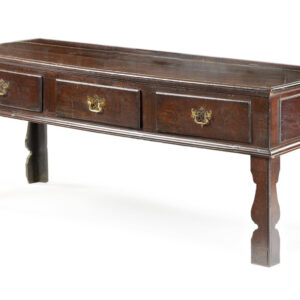
The two planked moulded top, above three fielded frieze drawers, having brass fret shaped handles and eschutcheons, raised on silhouette cut-baluster supports.
The interesting straight lines and clever silhouette shaped legs can place this in a complete modern setting or as a stand out entrance piece.
Three planked moulded top, above three friezed doors having decorative brass handles, raised on silhouette-baluster profile legs to front and side.
In thirty years of trading and forty years in the antiques trade,I have never stocked a dresser with silhouette legs. Even more unusual is that I now own two! Both from the same retiring English dealer that I purchased one dozen from. Actually my largest single purchase in my thirty years of business.
I’m moving into an apertment soon and am planing to take several dressers, one will have silhouette legs..
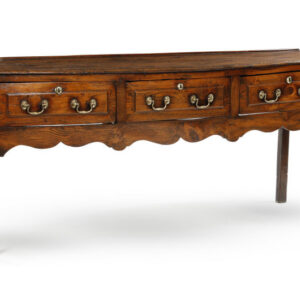
A rare mid 18th Century English elm low dresser, having an applied rear plate. Above an attractive ogee cut apron housing three field frieze drawers with brass swan neck handles raised on long cabriole legs terminating on a pad foot, ownership initial on one. I photographed the original single plank ‘adze’ finished backboard, as it is outstanding! (I could look at it all day)
Adze: form of an axe in which the blade is set at a right angle to the handle, used for dressing timber. Required skill. To use the cutting adze requires standing astride or on top of the log to be hewn.
Note: 35 years in the trade and this is only the second elm dresser I have stocked, as elm being such a soft timber rarely survives in such good condition.
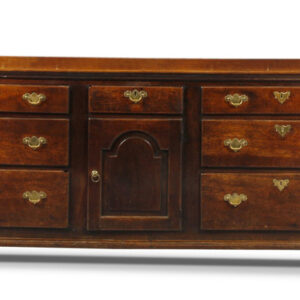
Having a central moulded drawer above an arched fielded cupboard door embraced either side by a bank of three drawers and slender cut corner pilasters on nice bracket feet.
Note: This dresser is still in need of a good clean and wax.
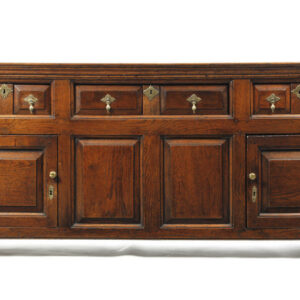
An unusual well panelled late 18th Century English oak dresser base. With three raised fielded drawers above a pair of central fixed fielded panels, flanked to either side by a conforming cupboard door, on extended stile supports. 1780 – 1800 H:82 cm W:186.5 cm D.48cm