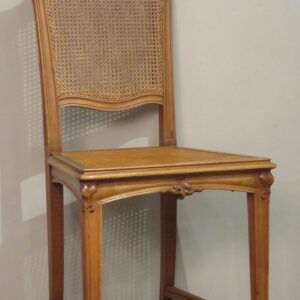
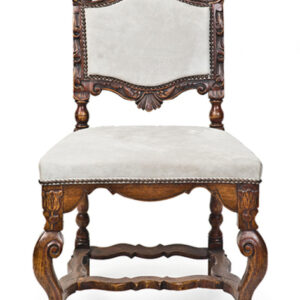
Set of Ten French Walnut Art Nouveau Dining Chairs Comprising six original and four later copies The shaped moulded top rail having carved leaf decoration A centre cane panelled back above a cane seat, resting on square moulded tapered legs, with matching carved decorations above, joined by an ‘H’ stretcher. All having detachable upholstered cushions. CIS500
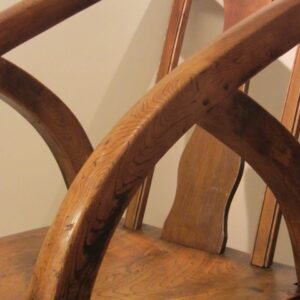
An unusual late 19th Century Northern European elm well shaped armchair
This is the first of this style I have seen in 33 years, there’s a definite Arts & Crafts feel with a Chippendale style rear splat, quite an unusual mix.
The long single plank bentwood arms flowing through to become legs with matching shaped stretchers all flow very well, then there’s that English influenced Splat flanked by two reeded uprights.
The thick single plank slight saddle seat seems to be holding all these unusual shapes together.
Anyway an interesting chair and quite a talking point this will be.
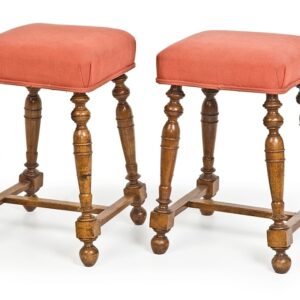
A rare pair of early 19th Century French fruitwood stools. The upholstered seats on well patinated fine baluster turned legs, joined by an ‘H’ stretcher.
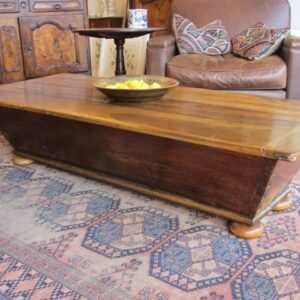
First half 19th Century French fruitwood dough bin/coffee table.
The well patinated cleated hinged top above four canted sides and a thick planked floor. The carcass having a richer patina due to less light and natural wear.
Once a dough bin, removed from stand and hinged the sliding top, clean and wax and great coffee table.
Note: can always be placed back to the base and back to original.
Early 19th Century French walnut and fruitwood coffee table.The beautifully grained faded cleated top, with chunky country dovetailed joints joining the canted corners, resting on bun feet.
The hinged top opening for storage of wines, blankets, rugs, newspapers etc… Good overall colour and patination.
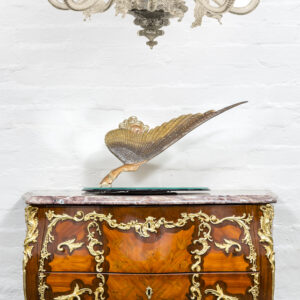
An exceptional and rare 19th century French fruit and rosewood, ormolu mounted, bombe-shaped commode of small proportions.
The serpentine shaped moulded marble top above the bombe-shaped base, housing two floral inlaid drawers.
The sunburst inlaid shaped side panels having central smiling faces.
The entire peice, profusely adorned by the most exceptionally decorative ormolu.
Note: every peice of ormolu is signed to the rear.
Resting on outswept tapered legs, terminating on a goats foot.
C.1870
H. 80cm W. 105cm D. 50cm
Recently restored by Shane Peter Smith at Smith & Allpress Restoration. He’s done a sterling job! Hand cleaning every piece of ormolu, then sealing, so will never tarnish again.
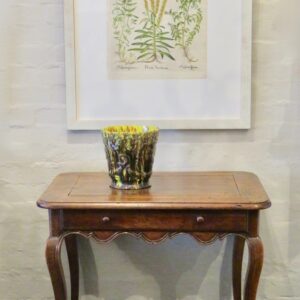
Late 18th Century French Walnut Louis XVIII Period Side Table
The well patinated rectangular central panelled cleated, moulded top, above an ogee shaped groove-moulded frieze, housing a rectangular drawer, retaining the original turned handles.
The moulded frieze, flowing though to the long slight cabriole legs, terminating to a scroll at the foot.
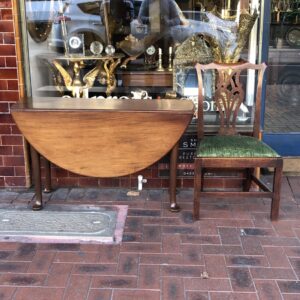
18th Century English George ll faded Mahogany Gate-Leg Table
The oval opened three plank top, unusual as usually several joined planks.
Supported by four turned tapered legs, terminating on a round pad-foot.
Good overall faded colour.
Recently restored by Smith & Allpress.
C.1760
These tables are one of Englands best inventions regarding furniture.
Having many different uses.
An attractive sofa/side/hall table.
A ‘D’ shaped sofa/serving table. Very useful for entertainers.
Or as a breakfast/dining table.
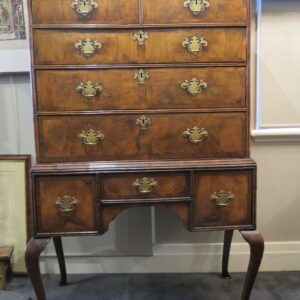
The covello moulded top above two short and three long graduated, figured walnut and cross banded drawers above a matching later three drawer base, resting on walnut cabriole legs, terminating on pad feet.
Note the beautiful country figured elm double plank sides.
A rare find indeed, another recent private purchase.
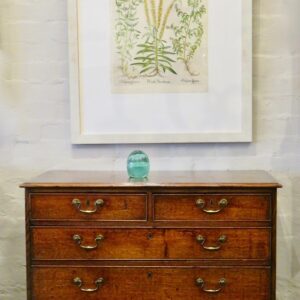
18th Century English country oak chest of unusually small proportions.
The well patinated moulded top, above two short and three long graduated cock-beaded drawers, all retaining the original brass swan-neck handles and escutcheons. Resting on low shaped bracket feet.