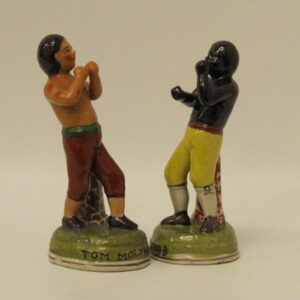
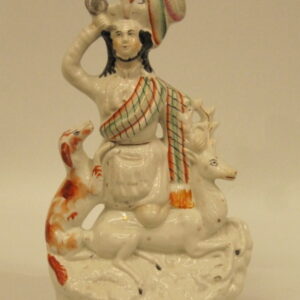
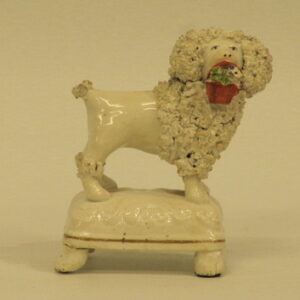
A pair of interesting fakes in 19th Century Staffordshire style boxing figures Tom Cribb & Tom Molyneux.
The appealing thing about these figures is that Tom Cribb was the white Englishman and Tom Molyneux was the American ex-slave , and the names have been incorrectly placed. also priced accordingly.
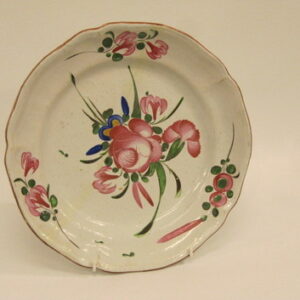
Early 18th Century French faience (tin glazed earthenware) plate, hand painted floral decoration (AF)
C. 1790
Diameter: 33 cm
Long before Europeans discovered the secret of making true porcelain, they began producing wares that emulated the exquisite blue and white products imported from Japan.
Majolica, delft, and faience are really names for similar ceramic products. An earthernware body is covered with an opaque in enameled glaze, usually colorfully decorated.
In France, three types of production have been used. The grand feu technique fired the clay once, then dipped it in the liquid glaze; the artist painted the design on the dried glaze, then the piece was fired. A later method was the petite feu where the piece was glazed and fired before the design was applied, then fired again. Faience fine, a later import from England, utilized a fine white clay covered with translucent glaze. The decoration was painted or transferred on the glaze and fired.
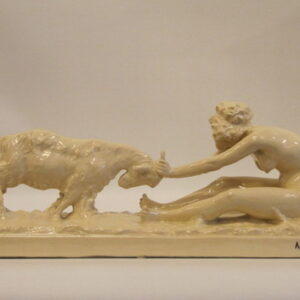
A superb French first quarter 20th Century composition of a naked Maiden playing with a goat (soft clay base).
Affortunato Gory was an Italian sculptor born in Florence in 1895 and died in France in 1925. He worked mainly in bronze or bronze and ivory but also produced a few spelter pieces. He exhibited in Paris. Affortunato moulded in the Art Nouveau period and designed many wonderful figures, including works for Goldscheider.
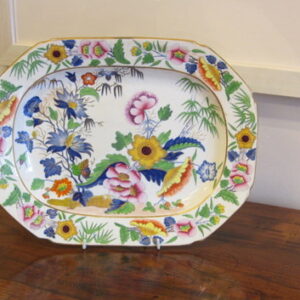
Good quality English Ironstone platter, ‘Britannicus Dresden China’
The wording ‘Britannicus Dresden China’ occurs printed in underglaze blue on good quality ironstone type table ware of the 1810 – 1825 period. This platter is printed in blue and enriched in brightly coloured enamels and gilt, with flowering plants in the Chinese taste.
This platter maybe attributed to Hicks & Meigh, a leading manufacturer.