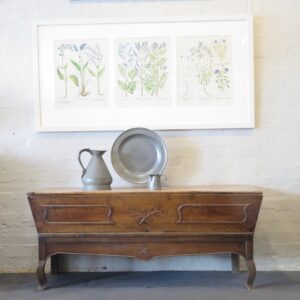
18th Century French Provincial Oak Petrin/Dough-Bin.

18th Century French Provincial Oak Petrin/Dough-Bin.

THIS ITEM HAS BEEN SOLD

The three plank cleated top (later hinged – originally sliding)
Above canted bin, with original leaf and moulded carving.
Resting on a shaped, moulded skirt with a carved central star, joined to front cabriole legs.

Still to be re-glued, and re wax finished.
Or left un waxed, as beautifully oxidised over the centuries.

H.68cm
W.155cm
D.57cm


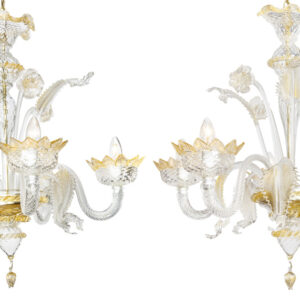
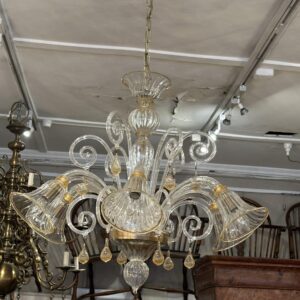
A Venetian Art Nouveau six branch chandelier.

A Venetian Art Nouveau six branch chandelier.

THIS ITEM HAS BEEN SOLD

Having beautiful flowing, stylish lines

Champagne and clear glass.

H.110cm (including chain & cup)

Dia.75c

Rewired, shined and cleaned to Australian Standards.


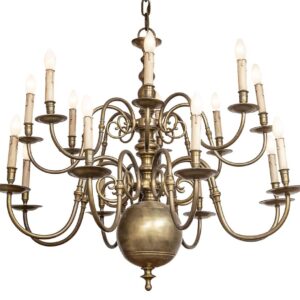
A large bronze two-tier 16 branch Flemish electrolier

A large bronze two-tier 16 branch Flemish electrolier


THIS ITEM IS SOLD

A large bronze two-tier 16 branch Flemish electrolier.

Cleaned and completely rewired to Australian standards.

H. 125 cm Dia. 130 cm excluding cup and chain (may be extended to any height)

19th Century Style Flemish Brass Electrolier of Wide Proportions

19th Century Style Flemish Brass Electrolier of Wide Proportions

THIS ITEM IS SOLD

19th Century Style Flemish Brass Electrolier of Wide Proportions

A double headed Eagle, above a beautifully turned coloumn, having eight scrolled arms.

‘One of the most intriguing and powerful ancient symbols is the mysterious double-headed eagle that has been with us for millennia. It is believed to be one of the world’s oldest symbols used by a number of diffrent ancient cultures. The earliest depiction of the double-headed eagle can be found on ancient Hittite monuments in central Anatolia. In the early 19th century, in Boğazkale, an old Hittite capital in modern-day Turkey Charles Texier discovered cylindric seals with clearly visible two-headed eagle with spread wings. The double-headed eagle motif originally dates from c. 3800 BC. The Hittites had worshipped the double headed eagle as the King of Heaven, who was also called the Hittite Bird of the Sun. The bird was their symbol to signify Hittite military power’ -messagetoeagle.com

H.140cm Dia.120cm

A rare and unusual, early 20th century French walnut Art Nouveau open shelved sideboard.

A rare and unusual, early 20th century French walnut Art Nouveau open shelved sideboard.

THIS PIECE HAS BEEN SOLD

The beautifully grained thick moulded marble top, above three narrow moulded drawers, with intertwined grapevine brass handles, then two panelled doors with matching grapevine carvings and escutcheons, having the original brass shaped key.

Flanked by open shelved ends, with matched moulded uprights, terminating to a slight splayed foot.

Elegant design, inspiring the upcoming delightful Art Deco period.

C.1900

H.101cm W.135cm D.48cm

Above,
A. A rare pair of 19th century Parisian Girandole four branch crystal and gilt table lamps.
B. Vintage “Portmeirion”
Sunflower botanical planter.
C. ‘Chandelier D’or’ watercolour on paper 2019 Mali Moir
73 x 79cm
Brachychiton bidwillii
(scientific plant name)
Zoom in on her perfect details.
An exceptional watercolour by Mali Moir.

In my opinion one of Australia’s most exceptional versatile artists. From botanicals to charcoals to portraits in any medium.

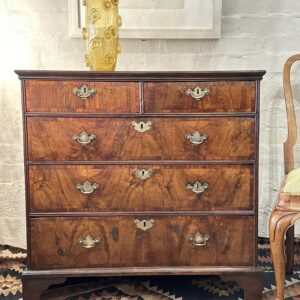
Rare 18th Century English Country Fruitwood Chest of diminutive proportions.

Rare 18th Century English Country Fruitwood Chest of diminutive proportions.

This chest is entirely made from single planks of timber, including the unseen floor (see last photo) which we discovered while lifting through to showroom.

The quarter sawn top and sides showing figurative grain, top with applied shaped mouldings.
The four long graduated drawers with later but appropriate brass-work (also unusual as generally two short then three long drawers).

Resting on a stylish, splayed bracket foot.

With well faded colour and patination.

H.94cm
W.80cm
D.45cm